
VIAL & SYRINGE CALCULATOR

Make the numbers instantly clear.

Enter the values you already have and the calculator will show the U-100 syringe marking, volume and concentration in plain language.

BEFORE YOU CALCULATE

The calculator should be the last step, not the first.

Use it to convert numbers you already have from a reliable source. It does not choose the dose, route or schedule.

WHAT ARE YOU TRYING TO WORK OUT?
↗Plan my dosesEnter a schedule that changes over time↓▦How many vials do I need?Calculate the total needed for a schedule→
YOUR VALUES

Enter what you know

We’ll take care of the maths. Change any value and the answer updates instantly.

LIVE
FIRST TIME USING THIS?Copy the numbers from the vial and the dose information you are already working from.

Example: a 30 mg vial + 3 mL liquid + a 4 mg amount. Enter those three numbers below and the calculator shows the U-100 syringe marking.

i
Many peptide vials have a 3 mL capacity.That is the vial capacity, not automatically the amount of water to add. The amount of liquid changes the concentration; in “Calculate my mix” the calculator suggests the volume needed for your chosen draw.
i
U-100 syringe markings measure volume.100 units = 1 mL.
VISUAL GUIDE

See the draw position

The fill and marker move automatically with your result.

DRAW TO30.0 U
10203040506070809010030.0 UU-100 scale · 0–100 units · 0–1 mL
YOUR ANSWER

Calculated draw

Here’s the result in plain terms.

DRAW THE SYRINGE TO
30.0units

With 20 mg in 3 mL, the 2 mg amount you entered equals 30.0 units on a U-100 syringe.

Equivalent volume0.300 mLHow much liquid that marking represents
Concentration6.67 mg/mLStrength of the mixed vial
2 mg→0.300 mL→30.0 units
How was this calculated?

First, vial amount ÷ liquid added gives the concentration. Then the amount you want ÷ concentration gives the volume in mL. On a U-100 syringe, 1 mL = 100 units.

COMPARE MIXING OPTIONS

See what changes when you add more or less water

There is not one automatic water volume for every vial. More liquid makes the mixture less concentrated and increases the syringe draw for the same amount; less liquid makes it more concentrated and reduces the draw.

Water addedConcentrationSame amount =
1 mL20.00 mg/mL10.0 units
1.5 mL13.33 mg/mL15.0 units
2 mL10.00 mg/mL20.0 units
2.5 mL8.00 mg/mL25.0 units
3 mL6.67 mg/mL30.0 units
What makes one option easier?A practical concentration usually gives a draw that is easy to see and measure on the syringe without needing an unnecessarily large volume. The vial's physical capacity sets an upper limit, but it does not tell you the correct diluent volume. Product-specific preparation instructions take priority where they exist.
TITRATION PLANNER

Plan a dose that changes over time

Add each stage of an existing schedule. The planner totals the amount across the full period rather than assuming the same amount every week.

Stage 1Weeks 1–4
Stage total2.00 mg
Stage 2Weeks 5–8
Stage total4.00 mg
Stage 3Weeks 9–12
Stage total8.00 mg
Total duration12 weeks
Total compound14.00 mg
Continue to vial planner →
About titrationThis planner calculates a schedule you enter; it does not decide when a dose should increase or what the amounts should be. For licensed medicines, use the authorised product information or a prescriber's schedule.
QUICK GUIDE

Mixing & administration

A simple visual walkthrough of reconstitution, common administration routes and a basic injection overview.
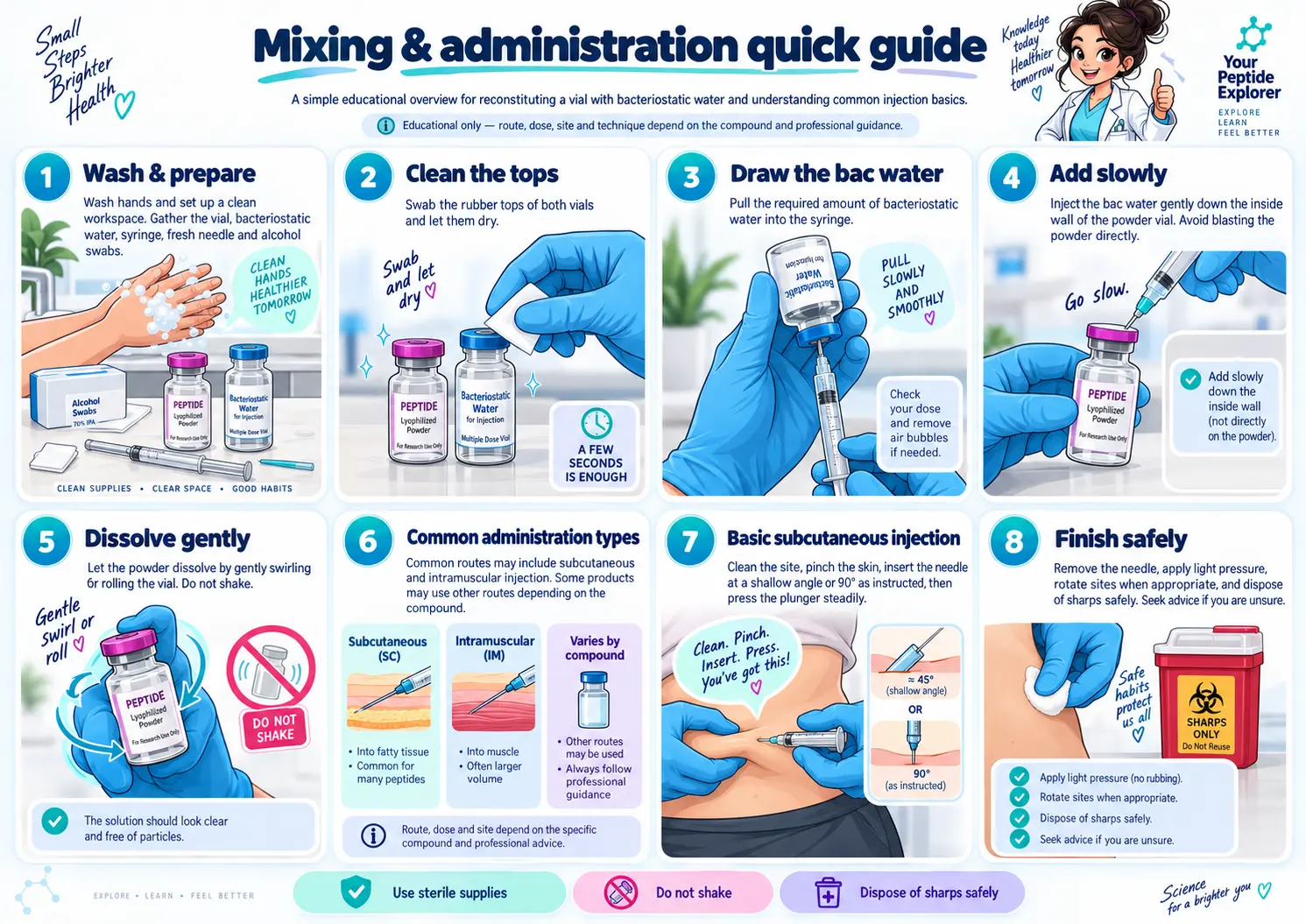
Illustrated quick guide showing how to mix a vial with bacteriostatic water, common administration routes and a basic injection overview
Educational overview only. Follow product instructions and appropriate clinical guidance for any real-world preparation or administration.
FREE MEMBERS AREA

Keep everything you’re exploring in one place.

Save peptides, build plans, set reminders and keep track of your own supplies in a private My Explorer space.

Save peptidesBuild plansSet remindersTrack supplies
FREENo subscription
Join free →Create your account in a couple of minutes.
Top