

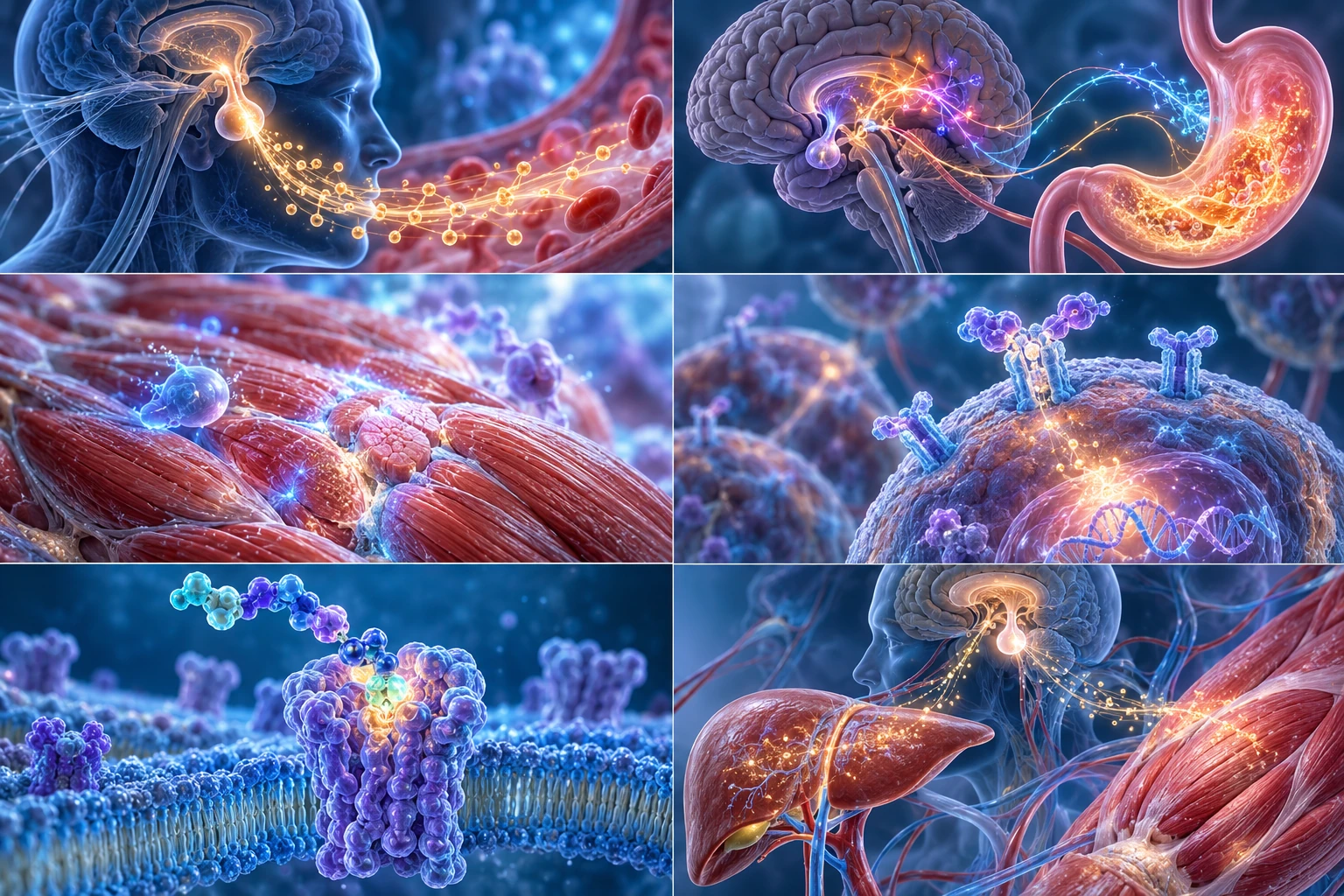
GHRELIN & GROWTH-HORMONE RESEARCH
GHRP-6
An early growth-hormone secretagogue with human research showing a clear hormone response and strong links with appetite signalling.
Growth hormoneGhrelin receptorAppetite
Human hormone-response evidence, without established performance efficacyGHRP-6 reliably stimulates GH in small human experiments. Evidence for muscle gain, fat loss, recovery or longevity is much less developed.
FOLLOW THE FULL PICTUREFrom interest to evidence, quality and the numbers.
Why are people interested in GHRP-6?
GHRP-6 became interesting because it can trigger a strong growth-hormone response in people. Its connection with the ghrelin receptor also links it with appetite, making it one of the better-known early growth-hormone secretagogues.
Appetite signalling
GHRP-6 belongs to the same secretagogue family linked with ghrelin signalling.
Explore the research →Recovery interest
GH biology naturally creates interest around tissue recovery and training.
Explore the research →THE SCIENCE BIT
A six-amino-acid signal through the ghrelin receptor.
GHRP-6 is a growth-hormone secretagogue: it stimulates release of the body's own GH through the ghrelin receptor, GHS-R1a. It does not supply growth hormone directly.
The same receptor family participates in appetite signalling. Human experiments establish an acute GH response, while broad recovery and body-composition outcomes remain less well demonstrated.
See the studies & trials →- GHS-R1a
- The receptor target
- Endogenous GH
- The hormone released
- Appetite pathways
- Related receptor biology
How this connects to the research
Acute hormone responses have stronger evidence than wider wellness claims.
FROM MOLECULE TO TISSUE
Where GHRP-6 connects with the body
These are the tissues and biological systems behind the interest in GHRP-6.
- Pituitary
- GH release.
- Brain networks
- Feeding-related signals.
- Liver and other tissues
- Downstream GH effects.
The research behind the interest
Growth-hormone release
Human studies show a clear, dose-related GH response.
The hormone response is established more clearly than any downstream physique or performance benefit.
Human mechanistic evidenceExplore the studies →Appetite signalling
GHRP-6 belongs to the same secretagogue family linked with ghrelin signalling.
Appetite effects are biologically plausible, although the strongest human food-intake evidence is often discussed for GHRP-2 and ghrelin.
Mechanistic + human endocrine contextExplore the studies →Recovery interest
GH biology naturally creates interest around tissue recovery and training.
Controlled trials have not established GHRP-6 as a recovery treatment.
Unproven clinical benefitExplore the studies →IGF-1 pathway
Repeated GH stimulation can influence the wider GH/IGF system.
That pathway also brings potential metabolic and endocrine trade-offs rather than a guaranteed benefit.
Human endocrine evidenceExplore the studies →Studies & trials
Studies & trials
Original publication · PubMed · trial registry where availableSelective stimulation of growth hormone release in healthy subjects ↗
17 healthy men
Intravenous infusion
Serum GH increased consistently at active dose levels and returned toward baseline after exposure.
Pharmacokinetic study of GHRP-6 in healthy volunteers ↗
Nine healthy men
Intravenous
The study characterised exposure after single GHRP-6 doses.
Evidence snapshot
Evidence snapshot
Separate dimensions, not one overall score◎
Human evidenceDeveloping
3/5 evidence depth
Small human studies establish GH release and pharmacokinetics.
✓
Clinical efficacyLimited
2/5 evidence depth
No robust clinical efficacy programme supports common physique or recovery claims.
◇
Safety evidenceLimited
2/5 evidence depth
Long-term safety data for repeated non-medical use are limited.
⌁
Preclinical evidenceDeveloping
3/5 evidence depth
Mechanistic secretagogue biology is well characterised.
HOW TO READ THESE SCORESDeveloping preclinical evidence · developing human evidence
These are editorial evidence-depth ratings on a 1–5 scale, not a statistical result or a single scientific formula. They summarise how much relevant evidence is present in each separate category and how mature that evidence is.
Human evidenceHow much direct research in people is available and how developed it is.
Clinical efficacyWhether human studies demonstrate meaningful outcomes for the claims being discussed.
Safety evidenceHow much human safety, tolerability and longer-term follow-up information is available.
Preclinical evidenceThe depth of laboratory and animal research supporting biological plausibility.
HOW THE EVIDENCE IS ORGANISED
GHRP-6 research profile
Research themes are shown separately from the strength of the human evidence so biological interest is not confused with proven clinical benefit.
RESEARCH AREA 01Growth hormone
RESEARCH AREA 02Ghrelin receptor
RESEARCH AREA 03Appetite
RESEARCH AREA 04Endocrine research
Mechanistic and preclinical findings are context for further research; they are not treated as equivalent to demonstrated human outcomes.
From promising signals to human evidencePreclinical research can reveal promising biological signals. Human studies show how far those signals have translated into real-world outcomes.
What people are exploring
COMMUNITY · USE CASES & EXPERIENCE
What people want to change with GHRP-6
Interest centres on GH release, appetite, recovery and body composition.
Explore the everyday goalsConceptual scientific illustration
THE PRACTICAL ATTRACTION
The goals behind the interest
What the desired change means in daily life, and what makes an experience useful to understand.
Eating enough to support training
Appetite is a central part of the attraction for people finding it difficult to meet food-intake goals. The useful question is whether increased hunger changes practical eating capacity.
- What makes a report informative
- Meal intake and comfortable eating alongside hunger.
- What can muddy the picture
- Eating more can itself change weight, recovery and training performance.
Recovery and growth-hormone interest
People hope that GH-axis stimulation will support recovery between sessions. Endocrine responses help explain the interest but do not establish the broader performance claim.
- What makes a report informative
- Function and recovery under a consistent training workload.
- What can muddy the picture
- Stacks and training adaptation make a single-compound effect hard to isolate.
Muscle gain and body composition
Bodybuilding interest concerns size, strength and appearance. A change in body weight needs to be interpreted alongside food intake and waist or strength changes.
- What makes a report informative
- Strength and body measurements with dietary context.
- What can muddy the picture
- Extra calories and fluid changes can be mistaken for a direct muscle-building effect.
PUT THE EXPERIENCE IN CONTEXT
How the goals compare with the research
Open an area to distinguish human findings from laboratory explanations.
Growth-hormone release
The hormone response is established more clearly than any downstream physique or performance benefit.
Evidence context: Human mechanistic evidence
Appetite signalling
Appetite effects are biologically plausible, although the strongest human food-intake evidence is often discussed for GHRP-2 and ghrelin.
Evidence context: Mechanistic + human endocrine context
Recovery interest
Controlled trials have not established GHRP-6 as a recovery treatment.
Evidence context: Unproven clinical benefit
IGF-1 pathway
That pathway also brings potential metabolic and endocrine trade-offs rather than a guaranteed benefit.
Evidence context: Human endocrine evidence
The biological rationale
GHRP-6 is a growth-hormone secretagogue: it stimulates release of the body's own GH through the ghrelin receptor, GHS-R1a. It does not supply growth hormone directly.
The same receptor family participates in appetite signalling. Human experiments establish an acute GH response, while broad recovery and body-composition outcomes remain less well demonstrated.
Research sources and further reading
Dose & duration
DOSE & DURATION
Research protocols · community patterns · calculator toolsSee the numbers in their proper context
See the amount, how often it was used and how long each study ran. Published human research and community descriptions each carry their own source label, so you can see where the numbers came from.
Source matters. The figures below show authorised, human-research or community-described protocols in their original context — not a personalised recommendation.
Research protocols do not establish a safe consumer, bodybuilding or anti-ageing dosing schedule.
No structured human dosing protocol has been added for this compound. That should not be interpreted as evidence for a community dosing schedule.
CALCULATOR TOOLS
Work with the numbers
Convert amounts, concentration, liquid volume and vial requirements. These tools do the arithmetic; they do not select a dose.
NEED HELP READING THE NUMBERS?Source labels, routes and dose termsOpen guide +
HOW WE LABEL NUMBERSKnow where a dose came from before you compare it.
Authorised labelHuman trialCommunity-describedBEFORE THE NUMBERS: CHECK THE PRODUCT
Understand peptide testing →A dose only means something if the vial contains what the label says.
Purity, identity, quantity, sterility and endotoxin testing answer different questions. Learn how to read a COA and why a high purity percentage is not the same as confirming the amount in the vial.
READ THIS PAGE IN THREE STEPS
Understand the study before the number
A dose only makes sense alongside the population, route, frequency and duration. Start with where the number came from, then look at how it was delivered and how long the study actually ran.
1Source
Was it an authorised label, a human trial or a community-described pattern?
2Route & frequency
How was it given, and how often? The same number by a different route may not mean the same exposure.
3Duration
Was this one dose, a short trial or long-term treatment? A study window is not automatically a recommended cycle.
ROUTES EXPLAINED
Plain-English guideWhat do the injection types mean?
Route means how a compound was delivered. It affects absorption and can completely change how a study should be interpreted.
SubQ / SCSubcutaneous
An injection into the fatty layer just under the skin.
Common in peptide and metabolic-drug studies. It usually aims for systemic absorption rather than treating only the spot injected.IMIntramuscular
An injection into muscle tissue.
Muscle can absorb a medicine differently from fat. An IM amount should not be assumed to be equivalent to a SubQ amount.IVIntravenous
Delivered directly into a vein.
This gives immediate bloodstream exposure and is commonly used in supervised research or clinical settings. It is not interchangeable with a home injection route.INIntranasal
Delivered through the nose rather than by injection.
The amount delivered depends on formulation and device. A spray count alone does not tell you the dose unless concentration and spray volume are known.Other routes you may see:Oral = swallowed.Topical = applied to skin or another surface.Implant = a formulation placed under the skin by a trained professional.
CALENDAR SETUP
Three-times-daily editorial example
Community example · not clinically validatedEach amount is per administration, not the daily total. Human acute infusion and pharmacokinetic studies do not validate this repeated subcutaneous programme.
Form and route: Injection under the skin, as described in the example
| Calendar stage | Amount each time |
|---|---|
| Weeks 1–2 | 100 mcg |
| Weeks 3–4 | 200 mcg |
| Weeks 5–12 | 300 mcg |
Frequency: Every day · 3 entries per scheduled day.
This copy stops at twelve weeks. The added times are editable calendar placeholders; they do not establish medically appropriate spacing.
PLAIN-ENGLISH GLOSSARYWhat do the dose terms mean?Open glossary +
mgmilligram
One thousand micrograms (mcg).
mcg / μgmicrogram
One thousandth of a milligram.
mcg/kgweight-based dose
The amount is calculated for each kilogram of body weight.
IUinternational unit
A measure of biological activity used for some medicines; it cannot be converted to mg without compound-specific information.
Routehow it was given
For example SubQ, IM, IV, intranasal, oral or topical.
Frequencyhow often
For example once daily, twice weekly or every seven days.
Titrationplanned step-up or step-down
A protocol changes the amount over time rather than using one fixed amount throughout.
Half-lifehow quickly levels fall
The time taken for the amount of a compound in the body to reduce by roughly half. It can influence study timing but does not by itself define a schedule.
Cyclea defined period of use
Usually means an on-period followed by a stop or review. Many community 'cycles' have not been clinically validated.
Maintenancea continuing phase
A longer-term amount or interval used after an initial phase when a study or authorised treatment actually defines one.
Reconstitutionturning powder into solution
Adding a specified liquid to a freeze-dried vial so a concentration can be calculated.
U-100 unitssyringe volume markings
100 units equals 1 mL on a U-100 insulin syringe. The markings show volume, not peptide mass.
Safety context
SAFETY & UNCERTAINTY
A potent endocrine signal needs endocrine context
What the current evidence saysGHRP-6 can alter growth-hormone signalling. Repeated long-term use, product quality and downstream metabolic effects are not well defined in consumer settings.
01 · OBSERVEDPublished safety findings
The summary above reflects the human or preclinical evidence currently represented on this profile.
02 · UNCERTAINGaps still matter
Limited follow-up, small studies or absent controlled trials can leave uncommon and longer-term risks unresolved.
03 · CONTEXTProduct and regulatory status
Route, product identity, quality and regulatory status can materially change the safety context; see the linked status sources below.
Sources & current status
READ FURTHER
Sources & current status
Follow the professional sources used across this profile, then see how the compound is currently described in regulatory and research terms.
KEY RESEARCH RECORD
6 sourcesSources used on this profile
Original publicationSelective stimulation of growth hormone release in healthy subjectsJournal / DOI ↗Bibliographic recordSelective stimulation of growth hormone release in healthy subjectsPubMed ↗Original publicationPharmacokinetic study of GHRP-6 in healthy volunteersJournal / DOI ↗Bibliographic recordPharmacokinetic study of GHRP-6 in healthy volunteersPubMed ↗Professional sourceUnited KingdomMHRA products database ↗Professional sourceUnited StatesDrugs@FDA ↗
CURRENT STATUS
How to interpret its position today
No UK-authorised medicine identified for this use
GHRP-6 is presented here for research context. Availability online does not establish medicine quality, safety or efficacy.
MHRA products database ↗No FDA-approved therapeutic product identified for this use
Published research and commercial availability are separate from regulatory approval.
Drugs@FDA ↗Profile reviewed against its linked source record on 20 September 2026. See how evidence is assessed.