
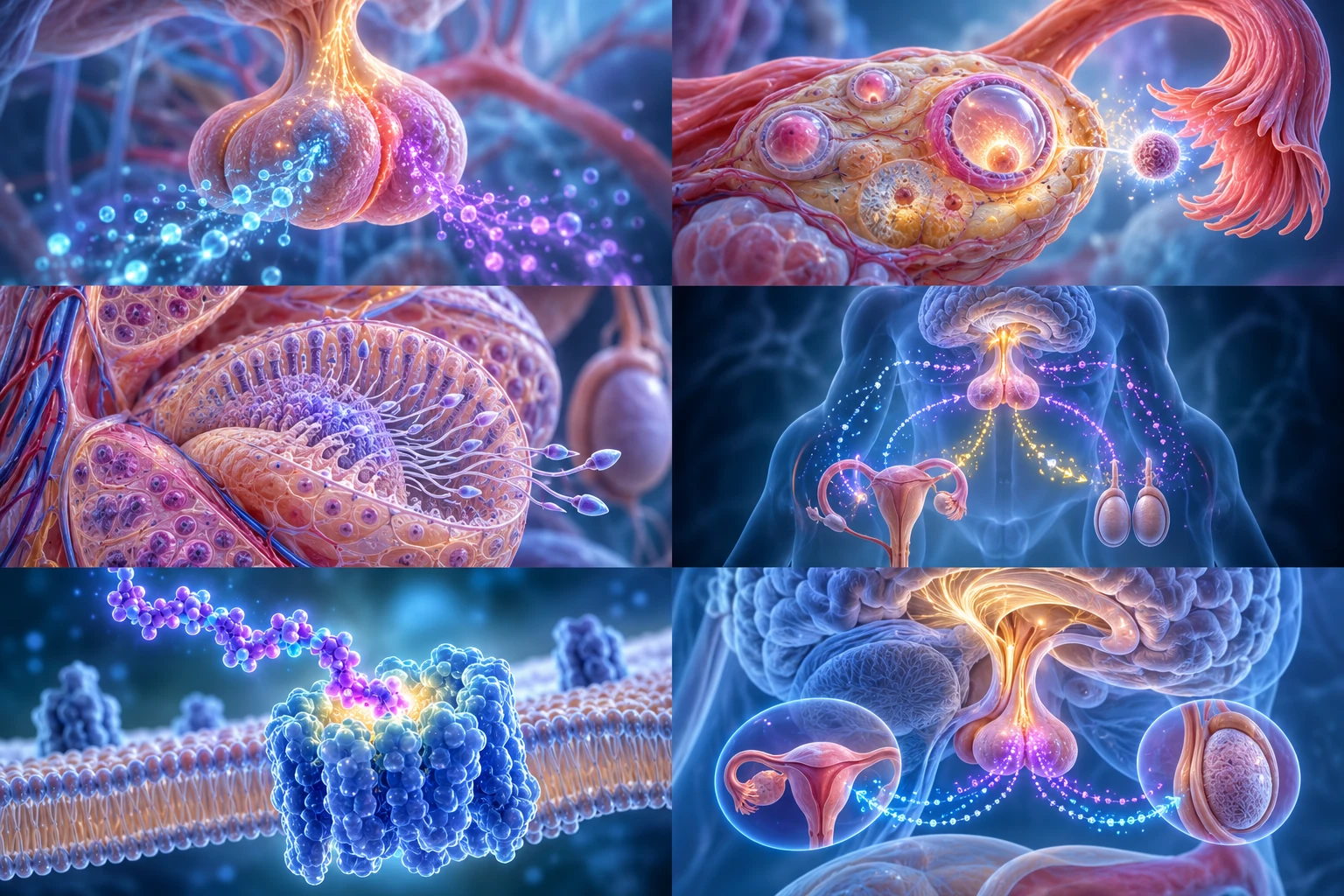
LH & FSH release
GnRH stimulates pituitary release of the gonadotropins that control ovarian and testicular function.
Explore the research →
A synthetic form of GnRH that activates LH and FSH signalling, with established reproductive biology and clinical research in selected fertility disorders.
Gonadorelin acts at the top of the reproductive hormone pathway, telling the pituitary to release LH and FSH. That makes its role unusually direct: in the right clinical setting it can restore the hormone pulses needed for ovulation and fertility.
GnRH stimulates pituitary release of the gonadotropins that control ovarian and testicular function.
Explore the research →Pulsatile GnRH has induced ovulation and pregnancy in women with hypothalamic amenorrhoea.
Explore the research →GnRH replacement can be relevant in selected men with hypogonadotropic hypogonadism who want fertility.
Explore the research →The appeal is restoration of a missing upstream signal rather than simply raising one downstream hormone.
Explore the research →Gonadorelin is synthetic GnRH. It activates GnRH receptors on the pituitary, prompting LH and FSH release and downstream reproductive-hormone activity.
Pattern matters: natural GnRH arrives in pulses. Pulsatile specialist treatment and continuous exposure can produce very different responses, so this is not simply a 'more signal means more hormones' system.
See the studies & trials →Established physiology and selected specialist clinical uses.
These are the tissues and biological systems behind the interest in Gonadorelin.
GnRH stimulates pituitary release of the gonadotropins that control ovarian and testicular function.
The effect depends strongly on timing: physiological pulsatile exposure and continuous exposure can produce very different responses.
Established human physiologyExplore the studies →Pulsatile GnRH has induced ovulation and pregnancy in women with hypothalamic amenorrhoea.
This is a defined medical use requiring diagnosis and monitoring.
Human clinical evidenceExplore the studies →GnRH replacement can be relevant in selected men with hypogonadotropic hypogonadism who want fertility.
It is not interchangeable with testosterone therapy and requires specialist endocrine care.
Clinical endocrine evidenceExplore the studies →The appeal is restoration of a missing upstream signal rather than simply raising one downstream hormone.
That distinction is why diagnosis and pulse pattern matter so much.
Established physiologyExplore the studies →12 women with hypothalamic amenorrhoea
Women with hypothalamic amenorrhoea
Extensive human endocrine and fertility literature exists.
Pulsatile GnRH is effective in selected hypothalamic reproductive disorders.
Safety is best characterised in supervised diagnostic/fertility settings.
Mechanism and reproductive physiology are well established.
These are editorial evidence-depth ratings on a 1–5 scale, not a statistical result or a single scientific formula. They summarise how much relevant evidence is present in each separate category and how mature that evidence is.
Research themes are shown separately from the strength of the human evidence so biological interest is not confused with proven clinical benefit.
Interest is mainly around fertility, LH/FSH signalling and preserving reproductive function.
Explore the everyday goalsWhat the desired change means in daily life, and what makes an experience useful to understand.
People are interested in stimulating their own LH and FSH rather than directly supplying downstream hormones. The key insight is that reproductive signalling depends on the pattern of stimulation.
Interest includes ovulation, sperm production and restoration of reproductive function. These are distinct clinical endpoints rather than consequences that can be assumed from one hormone rise.
Community interest can involve maintaining testicular function alongside other hormones. Accounts need to identify that background treatment because it changes the entire endocrine context.
Open an area to distinguish human findings from laboratory explanations.
The effect depends strongly on timing: physiological pulsatile exposure and continuous exposure can produce very different responses.
Evidence context: Established human physiology
This is a defined medical use requiring diagnosis and monitoring.
Evidence context: Human clinical evidence
It is not interchangeable with testosterone therapy and requires specialist endocrine care.
Evidence context: Clinical endocrine evidence
That distinction is why diagnosis and pulse pattern matter so much.
Evidence context: Established physiology
Gonadorelin is synthetic GnRH. It activates GnRH receptors on the pituitary, prompting LH and FSH release and downstream reproductive-hormone activity.
Pattern matters: natural GnRH arrives in pulses. Pulsatile specialist treatment and continuous exposure can produce very different responses, so this is not simply a 'more signal means more hormones' system.
See the amount, how often it was used and how long each study ran. Published human research and community descriptions each carry their own source label, so you can see where the numbers came from.
Clinical gonadorelin use depends on diagnosis, route and pulse pattern; there is no generic hormone-optimisation schedule.
Convert amounts, concentration, liquid volume and vial requirements. These tools do the arithmetic; they do not select a dose.
Purity, identity, quantity, sterility and endotoxin testing answer different questions. Learn how to read a COA and why a high purity percentage is not the same as confirming the amount in the vial.
A dose only makes sense alongside the population, route, frequency and duration. Start with where the number came from, then look at how it was delivered and how long the study actually ran.
Was it an authorised label, a human trial or a community-described pattern?
How was it given, and how often? The same number by a different route may not mean the same exposure.
Was this one dose, a short trial or long-term treatment? A study window is not automatically a recommended cycle.
Route means how a compound was delivered. It affects absorption and can completely change how a study should be interpreted.
An injection into the fatty layer just under the skin.
Common in peptide and metabolic-drug studies. It usually aims for systemic absorption rather than treating only the spot injected.An injection into muscle tissue.
Muscle can absorb a medicine differently from fat. An IM amount should not be assumed to be equivalent to a SubQ amount.Delivered directly into a vein.
This gives immediate bloodstream exposure and is commonly used in supervised research or clinical settings. It is not interchangeable with a home injection route.Delivered through the nose rather than by injection.
The amount delivered depends on formulation and device. A spray count alone does not tell you the dose unless concentration and spray volume are known.Clinical fertility protocols deliver repeated pulses through a programmed pump. Two or three weekly injections are not equivalent to that therapy. Record specialist appointments or the supplied schedule; the planner does not operate or replace a pulse pump.
Form and route: Pulsatile intravenous or subcutaneous GnRH delivery
The planner keeps amounts and repeat patterns blank for this compound. Use its formulation guide to record an independently specified schedule.
One thousand micrograms (mcg).
One thousandth of a milligram.
The amount is calculated for each kilogram of body weight.
A measure of biological activity used for some medicines; it cannot be converted to mg without compound-specific information.
For example SubQ, IM, IV, intranasal, oral or topical.
For example once daily, twice weekly or every seven days.
A protocol changes the amount over time rather than using one fixed amount throughout.
The time taken for the amount of a compound in the body to reduce by roughly half. It can influence study timing but does not by itself define a schedule.
Usually means an on-period followed by a stop or review. Many community 'cycles' have not been clinically validated.
A longer-term amount or interval used after an initial phase when a study or authorised treatment actually defines one.
Adding a specified liquid to a freeze-dried vial so a concentration can be calculated.
100 units equals 1 mL on a U-100 insulin syringe. The markings show volume, not peptide mass.
The summary above reflects the human or preclinical evidence currently represented on this profile.
Limited follow-up, small studies or absent controlled trials can leave uncommon and longer-term risks unresolved.
Route, product identity, quality and regulatory status can materially change the safety context; see the linked status sources below.
Follow the professional sources used across this profile, then see how the compound is currently described in regulatory and research terms.
Gonadorelin is presented here for research context. Availability online does not establish medicine quality, safety or efficacy.
MHRA products database ↗Published research and commercial availability are separate from regulatory approval.
Drugs@FDA ↗Profile reviewed against its linked source record on 20 September 2026. See how evidence is assessed.
Save peptides, build plans, set reminders and keep track of your own supplies in a private My Explorer space.