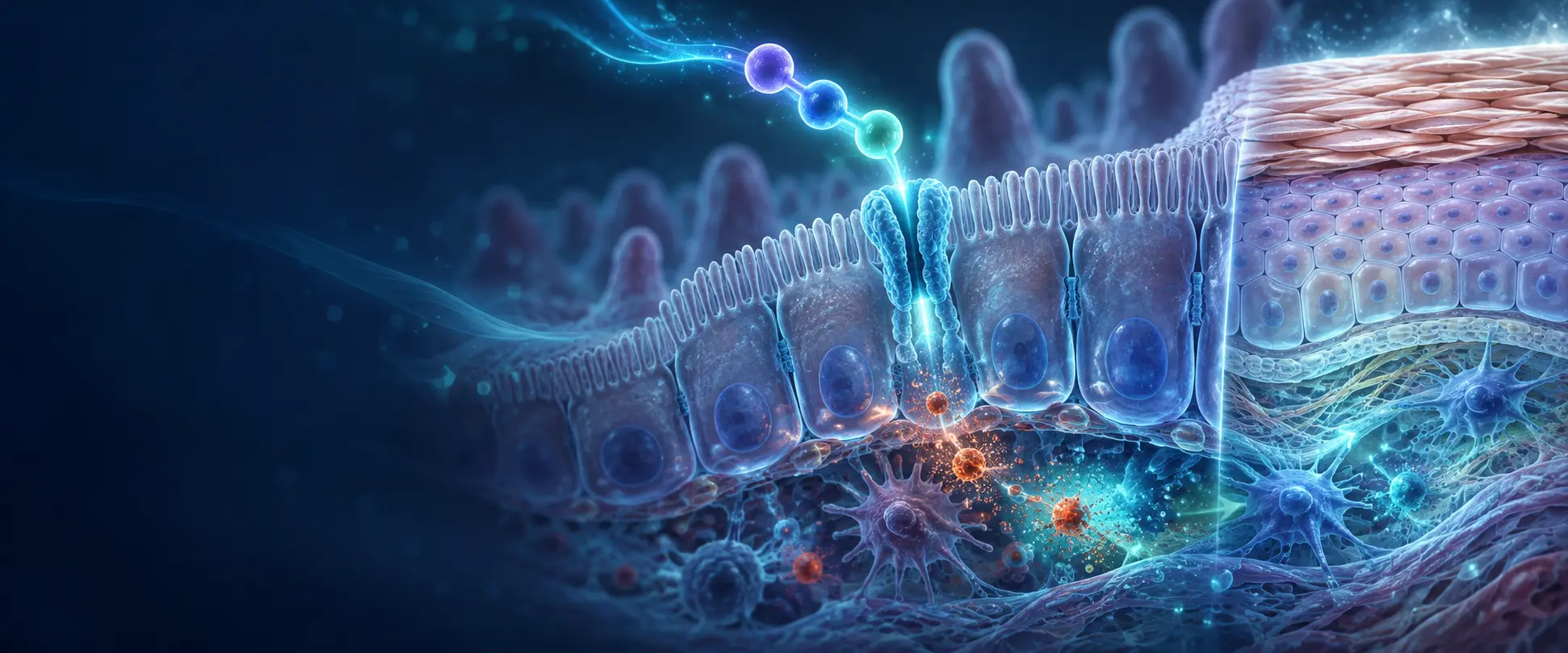
A small research peptide attracting interest around inflammation, gut health and skin support, with evidence still centred on early research.
Gut inflammationSkin barrierImmune signalling
A promising preclinical signal with a clear translation gapKPV repeatedly reduces inflammatory signals in cell and mouse models. FDA's 2026 review found no human exposure, pharmacology, efficacy or safety study for KPV by any route.
Explore KPV
WHY PEOPLE ARE INTERESTED
Why is KPV attracting interest?
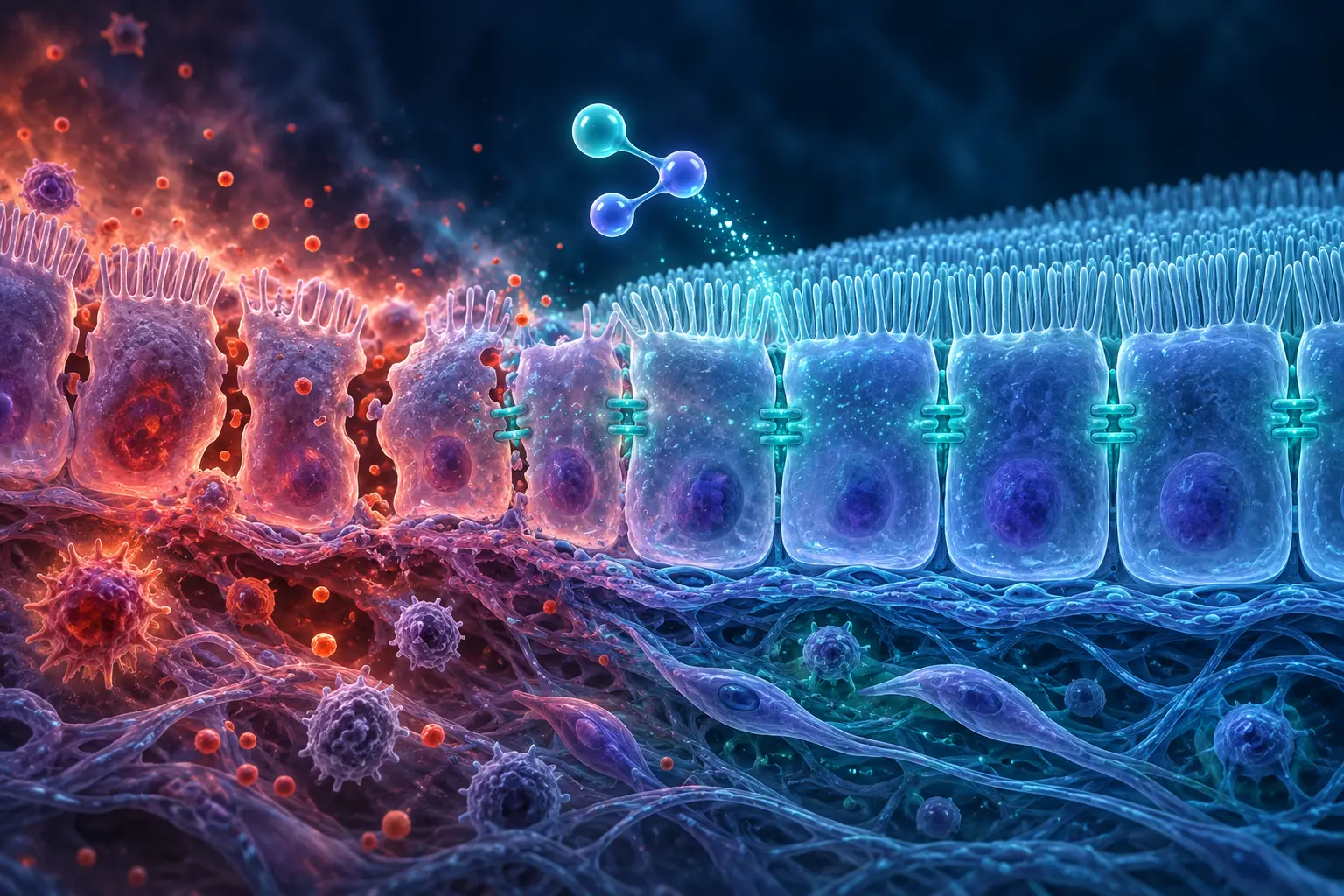
KPV is interesting because the same short peptide links transport through PepT1 with quieter inflammatory signalling and barrier-focused outcomes. The biology is coherent; demonstrating a useful, safe effect in people is the step that has not yet happened.
Start with the big picture
These cards show what KPV is best known for and where the interest comes from. When you want the detail, open Research for the studies or Evidence for a quick view of how strong the support is.
The main reasons this compound attracts attention. The Research and Evidence sections give you the deeper scientific picture.
Intestinal inflammation
Gut-barrier and colitis research is the best-developed KPV theme.
WHAT THE RESEARCH SAYS
PepT1-mediated uptake studies reported reduced inflammatory signalling and disease activity in intestinal cells and multiple mouse colitis models.
Evidence so farPromising preclinical evidence
Inflammatory signalling
KPV is explored as the anti-inflammatory C-terminal fragment of alpha-MSH.
WHAT THE RESEARCH SAYS
Cell studies report effects on NF-kB-related activity and pro-inflammatory cytokine signalling across intestinal and airway epithelium.
Evidence so farMechanistic evidence
Skin & keratinocyte research
Topical interest follows laboratory findings in human skin-cell systems.
WHAT THE RESEARCH SAYS
Keratinocyte and skin-permeation experiments provide a plausible topical research route, but they are not clinical dermatology trials.
Evidence so farHuman cells · no treatment trial
Barrier-protection potential
KPV is discussed where inflammation and epithelial damage overlap.
WHAT THE RESEARCH SAYS
Gut and skin models suggest a potential to protect or restore barrier tissues; whether this translates into meaningful healing in people is unknown.
Evidence so farPreclinical evidence
Interest first. Evidence next.We start with why people are talking about KPV, then show what the research actually supports so you can see the full picture.
HOW THE RESEARCH STORY CONNECTS
A small peptide with a surprisingly coherent barrier pathway
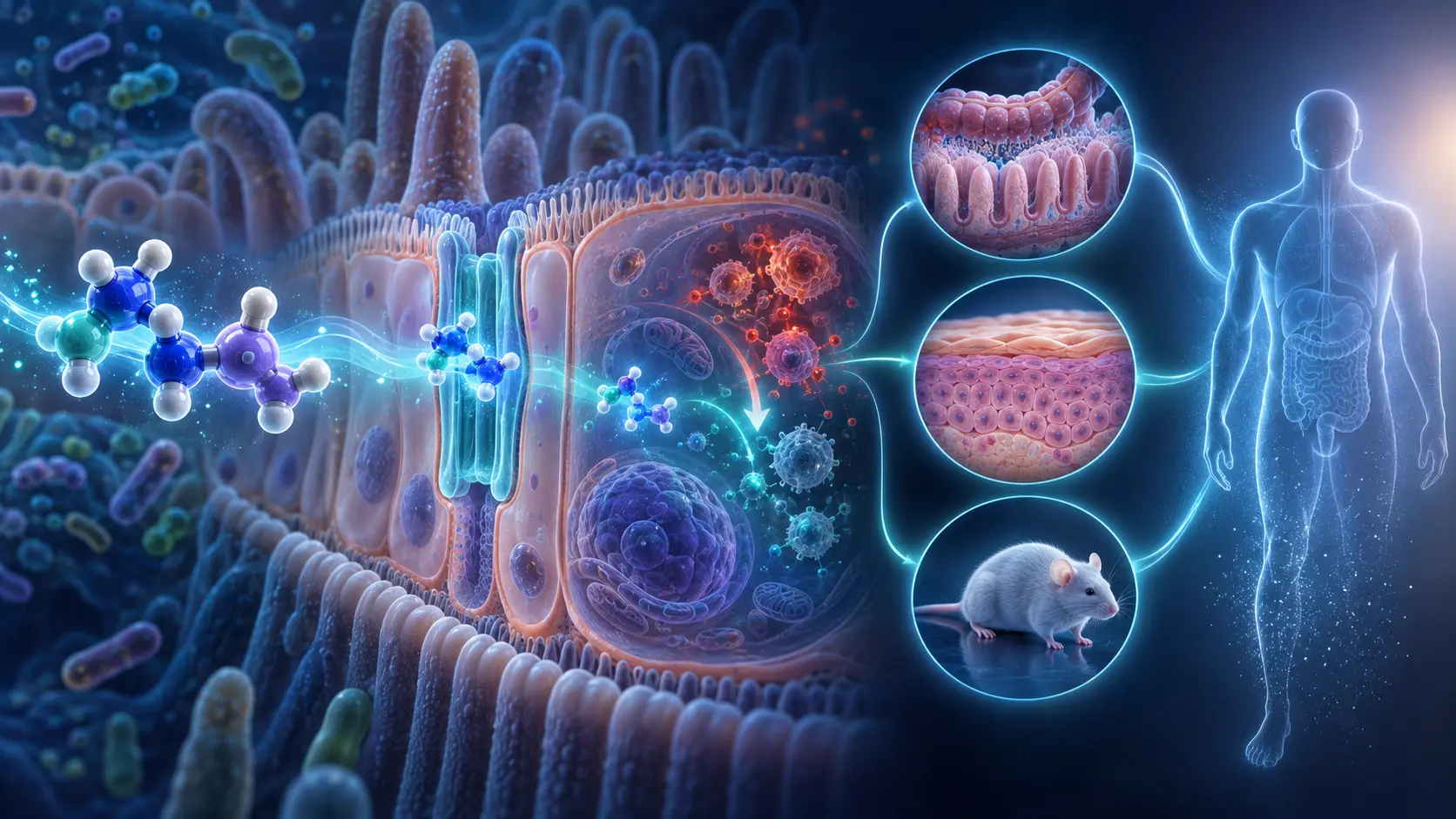
Transport → signalling → tissue model
01
TRIPEPTIDEKPV · Lys-Pro-Val
A three-amino-acid fragment at the C-terminal end of alpha-MSH.
→
02
TRANSPORTPepT1 can carry KPV
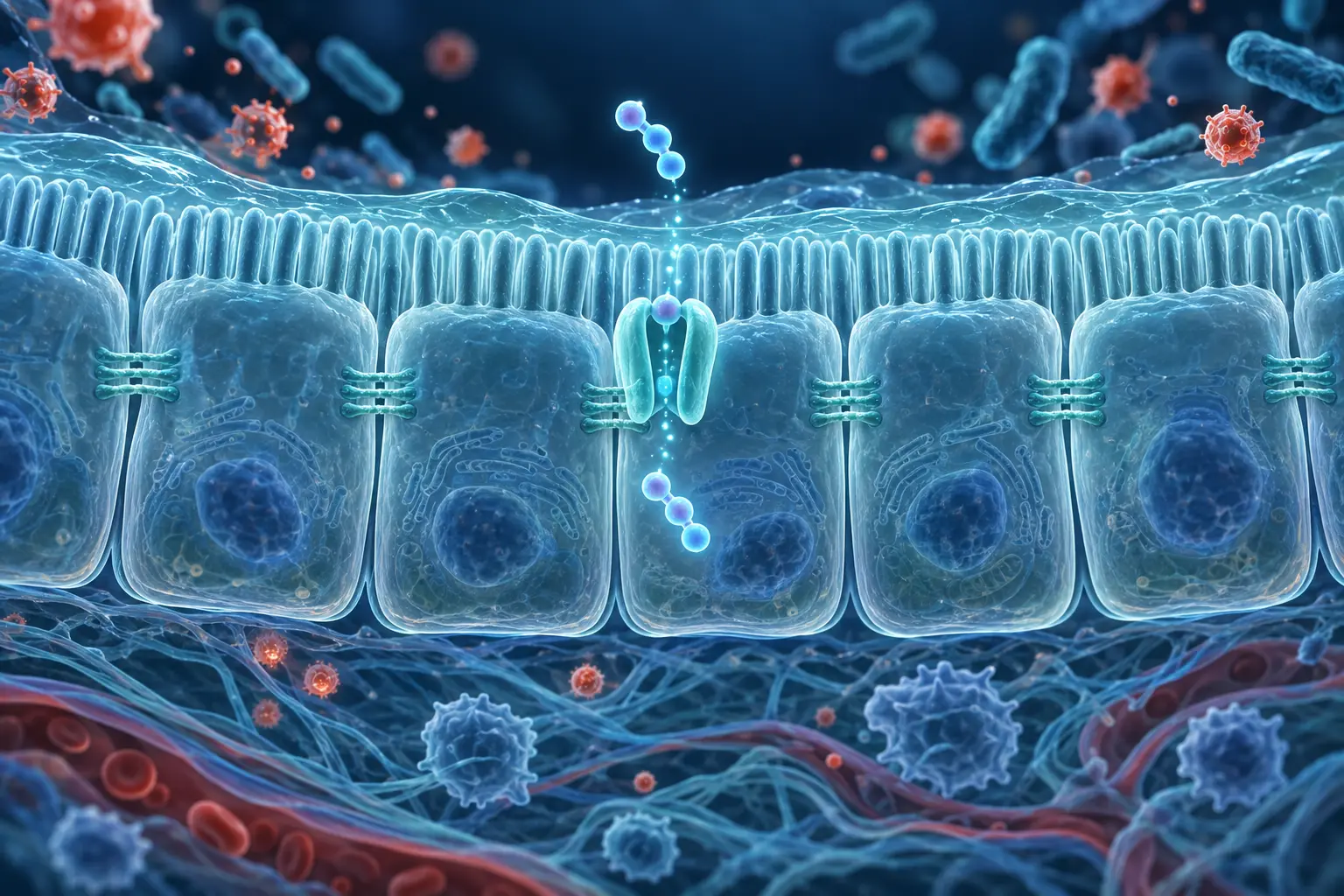
Intestinal research shows KPV entering epithelial cells through the peptide transporter PepT1.
Mouse and tissue models report less inflammation and stronger epithelial recovery signals.
The opportunity
KPV links a plausible transport mechanism with repeat anti-inflammatory findings across gut and epithelial models. That gives researchers a specific hypothesis to test—not merely a broad wellness claim.
The missing bridge
No controlled human KPV treatment programme has yet shown which route, dose or formulation reaches tissue and produces a meaningful benefit.
WHAT RESEARCH IS EXPLORING
A transport-led anti-inflammatory story across gut and skin barriers
KPV is not simply described as anti-inflammatory. Experimental research connects a defined tripeptide, PepT1-mediated uptake and downstream epithelial signalling. That makes the biology unusually easy to map—even though direct human treatment evidence is still absent.
01
Peptide transport
PepT1 can transport di- and tripeptides, and intestinal experiments identify it as an important route for KPV uptake.
02
Inflammatory signalling
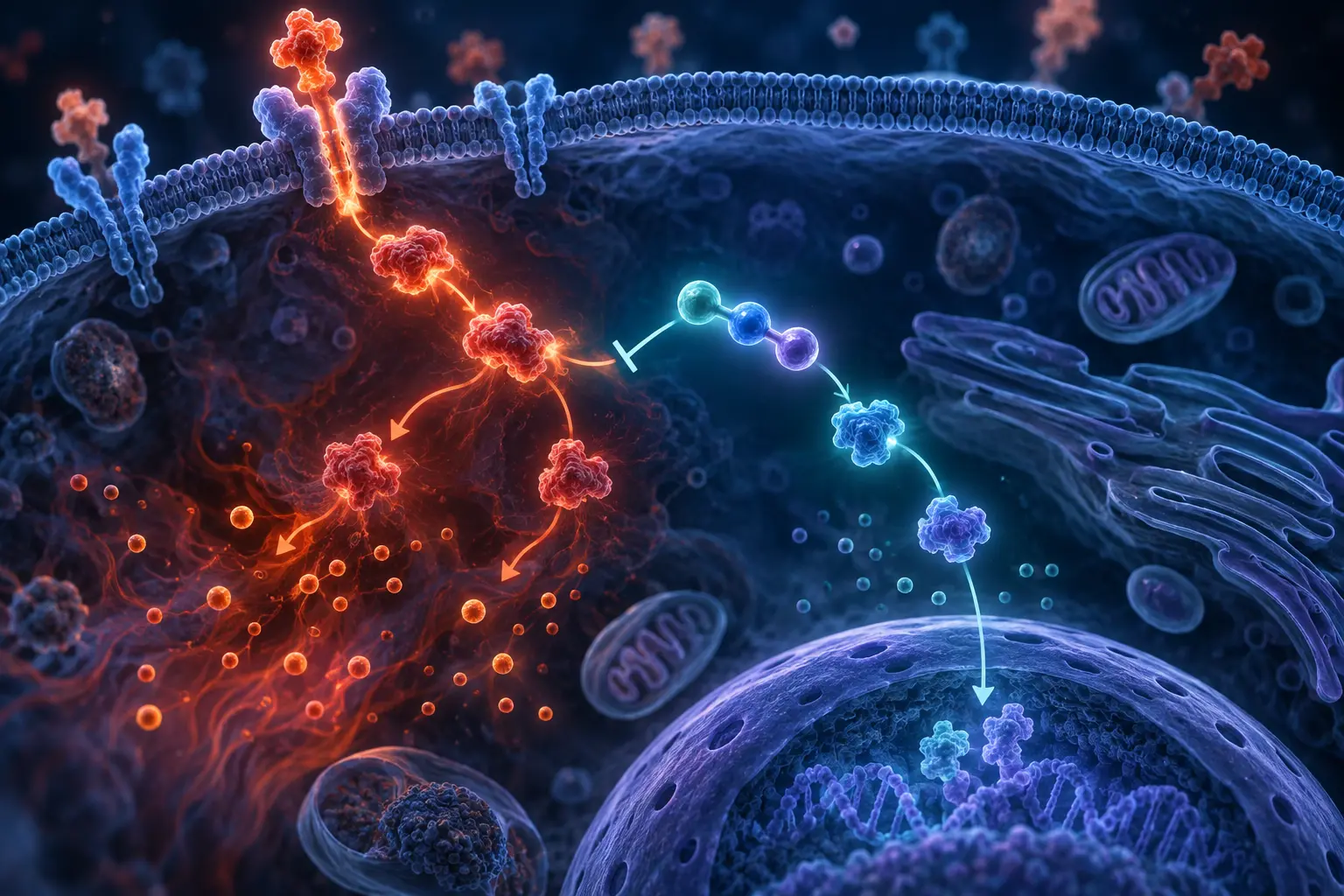
Cell research reports lower NF-kB-related activation and reduced expression of selected pro-inflammatory cytokines.
03
Barrier outcomes
Mouse colitis, oral-delivery and epithelial studies repeatedly report improved inflammatory or tissue measures.
04
Human boundary
Human cells and biopsy specimens are not human treatment trials; clinical exposure, dose, efficacy and safety remain unestablished.
RESEARCH LANDSCAPEKPV · PepT1 · epithelial signalling · translation gap
Human colorectal biopsy specimens and genetically modified mouse models
PepT1 expression was increased in human colorectal tumour specimens; KPV intervention reduced inflammation-associated tumorigenesis in PepT1-expressing mice.
The human material established transporter context only—KPV was not tested as a cancer treatment in people.
FDA's 2026 review did not identify KPV products administered to humans by any route.
✓
Clinical efficacyEarly
1/5 evidence depth
No controlled human treatment trial establishes benefit for gut, skin, wound or inflammatory conditions.
◇
Safety evidenceEarly
1/5 evidence depth
Human pharmacokinetics, immunogenicity, dose-response and longer-term safety remain unknown.
⌁
Preclinical evidenceStrong
4/5 evidence depth
Repeated cell, tissue and mouse findings support a coherent anti-inflammatory and barrier-research rationale.
HOW TO READ THESE SCORESStrong preclinical evidence · early human evidence
These are editorial evidence-depth ratings on a 1–5 scale, not a statistical result or a single scientific formula. They summarise how much relevant evidence is present in each separate category and how mature that evidence is.
Human evidenceHow much direct research in people is available and how developed it is.
Clinical efficacyWhether human studies demonstrate meaningful outcomes for the claims being discussed.
Safety evidenceHow much human safety, tolerability and longer-term follow-up information is available.
Preclinical evidenceThe depth of laboratory and animal research supporting biological plausibility.
EVIDENCE LANDSCAPE
The mechanism repeats. Human translation has not begun.
The strongest KPV case is convergence: several experiments point toward anti-inflammatory and barrier effects. The limitation is equally clear— none establishes a treatment effect or safety profile in people.
2008 · MECHANISMPepT1 transport and cell signalling
Human intestinal cell systems plus mouse colitis models.
2008–2017 · REPLICATIONMultiple gut models and delivery systems
Positive animal findings across colitis and targeted oral formulations.
SKIN · LABORATORYKeratinocyte and permeability research
Human cells and excised skin can inform mechanism, not clinical efficacy.
HUMAN TREATMENT · MISSINGNo validated exposure, dose or outcome
FDA's 2026 review found no human KPV exposure data by any route.
From promising signals to human evidencePreclinical research can reveal promising biological signals. Human studies show how far those signals have translated into real-world outcomes.
What people are exploring
PEOPLE & EXPERIENCE
Why people are exploring KPV
Gut comfort, calmer-looking skin and barrier support—mapped against a coherent laboratory story and an important lack of human exposure data.
Community goals · professional sources · route boundaries
Why this matters
People are drawn to KPV because its gut, skin and inflammatory-signalling themes fit together unusually well. The potential is worth explaining clearly, while the absence of direct human exposure data means reported benefits, preferred routes and safety assumptions remain unvalidated.
Experiences can reveal recurring goals, perceived changes and practical questions that formal studies may not yet address. They can suggest what deserves investigation, but cannot isolate the effect of one compound from rehabilitation, time or other changes.
+
⌁WHAT RESEARCH ADDSScientific context
Human and preclinical research helps test whether an idea is biologically plausible, whether it appears in people and how confidently the result can be separated from chance, bias or other parts of recovery.
01Very frequently discussed
Very frequently discussedPositive interest with important uncertainty
Gut comfort and inflammatory bowel interest
The clearest community goal is calmer gut symptoms and stronger barrier function, often in people already managing complex inflammatory conditions.
HUMAN EVIDENCE
No controlled KPV treatment trial has established benefit in inflammatory bowel disease, and KPV should not replace diagnosis or proven care.
A credible topical research direction that still needs controlled clinical testing.
03Growing practical interest
Growing practical interestPositive interest with important uncertainty
Oral versus injected KPV
People compare oral exposure for gut-focused goals with injection for broader systemic effects, even though route equivalence has never been established.
HUMAN EVIDENCE
FDA's 2026 review identified no human pharmacokinetic or pharmacodynamic study by any route.
The short sequence is scientifically interesting, but safety still requires evidence and product-quality control.
◇
Experience can start the question. Research has to test it.
Community reports can surface patterns worth exploring. Controlled human research is what tests whether those patterns are reliable, clinically meaningful and attributable toKPV, while the available studies show how far that question has already been answered.
Dose & duration
DOSE & DURATION
See the numbers in their proper context
Compare published study protocols with the patterns people discuss in the community. The two are intentionally kept separate so an anecdotal routine is never mistaken for clinical guidance.
Research protocols · community patterns · calculator tools
Research dose ≠ recommendation. A dose used in a study describes that study only and does not establish an appropriate dose for an individual outside the research setting.
ONE ANECDOTAL COMMUNITY EXAMPLE
A low-start pattern with a deliberate review point
This visual reflects a recurring published community range for oral or subcutaneous KPV. It has not been tested in a human KPV dose-finding study and is not a recommendation.
ANECDOTAL · UNVALIDATED
1Week 1
200 mcg · once daily
Commonly published anecdotal start
2Weeks 2–4
200–500 mcg / day
Some descriptions step up within this range
3Weeks 5–8
Continue or stop
Community course lengths vary
4After course
Pause & review
No evidence-based break interval
What people commonly discuss200 mcg once daily as a start, with some protocols moving toward 500 mcg daily over a four-to-eight-week course.
What remains completely unvalidatedThe dose range, step-up, duration and pause have not been linked to human KPV pharmacology, clinical efficacy or safety outcomes.
ORALGut-focused community rationale
Mouse oral findings used specific experimental conditions and do not establish absorption from retail capsules.
TOPICALFormulation decides exposure
Concentration, vehicle and skin permeability vary; a topical percentage is not equivalent to a microgram injection.
SUBCUTANEOUSSystemic exposure is assumed, not mapped
No human pharmacokinetic study defines absorption, half-life, tissue exposure or dose-response.
THE MOST IMPORTANT SOURCE BOUNDARY
FDA's 2026 evidence review identified no clinical study or human exposure data for KPV by any route. The numerical example above is therefore labelled community-described only.
No validated human KPV dose, route, titration method or course length exists. The figures below describe a recurring community pattern—not a treatment protocol.
No structured human dosing protocol has been added for this compound. That should not be interpreted as evidence for a community dosing schedule.
COMMUNITY DISCUSSION
What people commonly discuss
Anecdotal / unvalidated
STARTING APPROACHES
200 mcg once daily is a commonly published anecdotal starting amount for oral or subcutaneous use; topical products use formulation-specific concentrations and are not comparable.
DURATION / CYCLES
Community descriptions commonly use daily dosing for four to eight weeks, sometimes moving within a 200–500 mcg daily range.
MAINTENANCE DISCUSSION
A pause and review after a short course is often discussed, but no maintenance dose or evidence-based break interval has been validated.
Community patterns are anecdotal and unvalidated unless a linked human study independently supports the same approach.
Often combined with
OFTEN COMBINED WITH
Why people explore pairings with KPV
See the thinking behind community-named stacks, the different role each component is proposed to play, and how much of that idea has actually been tested as a combination.
Community rationale · component roles · evidence boundary
Potential first, evidence in context. Pairings are usually explored because their research stories appear complementary. That makes them interesting to study, but does not yet prove extra benefit or safety.
CURRENT COMPOUNDKPV
→
OFTEN EXPLORED WITHKPV + BPC-157
KPV + BPC-157
→
OFTEN EXPLORED WITHKPV + GHK-Cu
KPV + GHK-Cu
→
OFTEN EXPLORED WITHKPV + condition-specific care
KPV + Established treatment
Combination-specific human research is the strongest evidence for what a pairing adds. Evidence for either ingredient alone should not be silently transferred to the combination.
KKPV IS USUALLY DISCUSSED AROUNDInflammatory signalling and epithelial barriers
Its appeal comes from a consistent preclinical story across PepT1 transport, gut inflammation and skin-cell research.
+
PTHE PAIRED APPROACH MAY ADDRepair biology, tissue remodelling or established care
Those roles may sound complementary, but no controlled human study shows that a KPV pairing adds benefit or remains safe.
Oral, topical and injected KPV are different exposure hypotheses—not interchangeable formats.
02Keep the component evidence separate
A finding for BPC-157, GHK-Cu or standard care does not become evidence for the combination.
03Do not replace proven treatment
Gut inflammation, persistent rash and wounds may need diagnosis and established condition-specific care.
Safety context
◇
SAFETY & UNCERTAINTY
Interesting biology; an uncharacterised human safety profile
01ENCOURAGING CONTEXTSeveral models point in the same direction
Repeated anti-inflammatory findings across gut, airway and skin systems justify continued research into KPV's potential.
02THE HUMAN GAPNo route has a characterised safety profile
FDA found no human exposure data, clinical pharmacology or safety study for oral, topical, injected or other KPV administration.
03PRODUCT-LEVEL RISKIdentity, impurities and aggregation matter
A short peptide can still be misidentified, contaminated, degraded or aggregated; injected products add sterility and concentration risk.
What the current evidence saysFDA's 2026 review found no clinical studies or human exposure data for KPV by any route. Potential safety risks, pharmacokinetics, immune responses and longer-term effects therefore remain unknown. Oral, topical and injected exposure must not be treated as interchangeable, and product identity, impurities, aggregation and sterility can add separate risks.
01 · OBSERVEDPublished safety findings
The summary above reflects the human or preclinical evidence currently represented on this profile.
02 · UNCERTAINGaps still matter
Limited follow-up, small studies or absent controlled trials can leave uncommon and longer-term risks unresolved.
03 · CONTEXTProduct and regulatory status
Route, product identity, quality and regulatory status can materially change the safety context; see the linked status sources below.
ROUTETopical does not mean exposure-free
Vehicle and barrier disruption can alter skin penetration, while systemic absorption has not been characterised.
SYMPTOMSDo not let experimentation delay diagnosis
Persistent bowel symptoms, bleeding, severe pain, fever, spreading rash or a non-healing wound require medical assessment.
INTERACTIONSAbsence of data is not absence of interaction
Effects alongside anti-inflammatory, immune-modifying or other peptide products have not been adequately studied.
Not FDA-approved; the 503A process remained unresolved after the July 2026 advisory vote
FDA staff proposed against listing KPV because of poor characterisation and absent human effectiveness and safety data; the advisory committee later recommended inclusion. That recommendation is non-binding and does not establish drug approval, efficacy or safety.