A focused preclinical signal with no human treatment evidencePE-22-28 has a clear molecular target and encouraging mouse-model findings. No controlled human trial has established antidepressant benefit, pharmacokinetics, a dose or long-term safety.
Explore PE-22-28
WHY PEOPLE ARE INTERESTED
Why has PE-22-28 attracted research interest?
PE-22-28 is unusually specific for an experimental peptide: it was designed from spadin, tested against TREK-1 and compared with its parent sequence. The remaining translation gap is still very large.
Start with the big picture
These cards show what PE-22-28 is best known for and where the interest comes from. When you want the detail, open Research for the studies or Evidence for a quick view of how strong the support is.
The main reasons this compound attracts attention. The Research and Evidence sections give you the deeper scientific picture.
Potent TREK-1 blockade
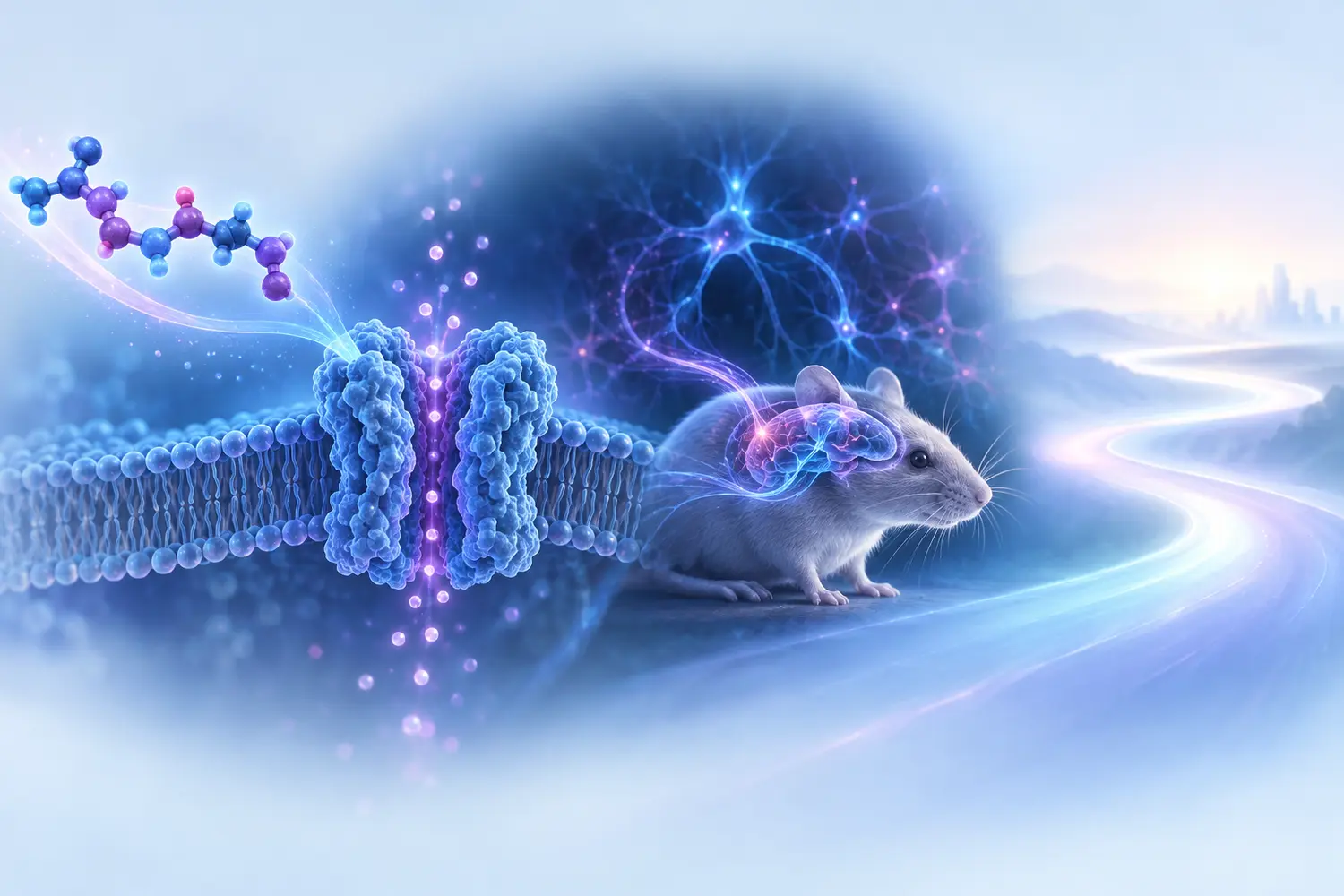
PE-22-28 was designed to inhibit the two-pore potassium channel TREK-1, a target linked experimentally with mood pathways.
WHAT THE RESEARCH SAYS
The 2017 study reported an in-vitro IC50 of 0.12 nM and selectivity for TREK-1, but target potency does not predict a safe or effective human dose.
Evidence so farStrong mechanistic evidence
Antidepressant-like behaviour
Mouse behavioural tests produced the principal benefit signal associated with PE-22-28.
WHAT THE RESEARCH SAYS
Reduced immobility in forced-swim testing is an experimental screening outcome, not evidence that depression improves in people.
Evidence so farAnimal evidence only
Neurogenesis signal
Short treatment was associated with markers of hippocampal neurogenesis in mice.
WHAT THE RESEARCH SAYS
The finding supports biological follow-up, but cell-generation markers cannot establish improved mood, cognition or resilience in humans.
Evidence so farPreclinical evidence
Longer experimental action
The shortened analogue was created to improve stability and activity compared with parent spadin.
WHAT THE RESEARCH SAYS
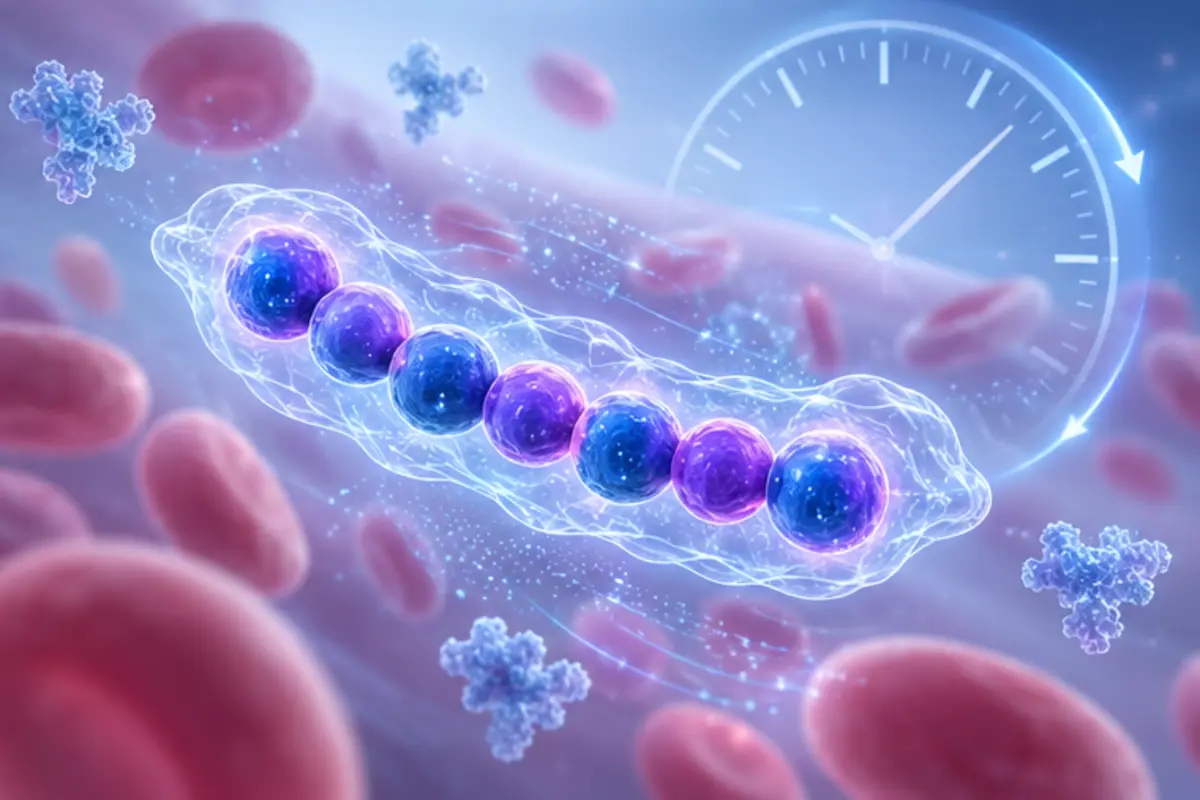
Mouse data suggested activity lasting about 23 hours versus roughly seven hours for spadin; human exposure and half-life are unknown.
Evidence so farComparative animal evidence
Interest first. Evidence next.We start with why people are talking about PE-22-28, then show what the research actually supports so you can see the full picture.
HOW TO READ THE RESEARCH STORY
A precise TREK-1 experiment before the first human step
PE-22-28 improves the potency and experimental persistence of parent spadin in preclinical work. The evidence story is coherent—but it currently ends with cells and mice.
GVSWGLR
01Seven residues
Shortened sortilin-derived spadin analogue
→
02TREK-1 block
Sub-nanomolar inhibition in experimental systems
→
03Mouse signal
Behaviour and hippocampal neurogenesis
→
04Human horizon
No clinical dose, efficacy or safety programme
WHAT PRECLINICAL RESEARCH IS EXPLORING
A seven-residue TREK-1 blocker with a clearly unfinished translation story
The attraction is not vague: PE-22-28 was engineered from spadin for stronger TREK-1 inhibition and longer experimental action. The important missing layer is any administered-human evidence.
01
Target potency
The original paper reports potent and selective TREK-1 inhibition in its experimental systems.
02
Behaviour
Antidepressant-like results come from mouse screening tests, not diagnosed human depression.
03
Neurogenesis
Hippocampal cell-generation markers provide a follow-up mechanism rather than a clinical outcome.
04
Translation
Human pharmacokinetics, route, dose, efficacy and psychiatric safety remain uncharacterised.
RESEARCH LANDSCAPETREK-1 · mouse behaviour · neurogenesis · human gap
GVSWGLRTREK-1Spadin analoguePreclinical only
Studies & trials
Studies & trials
Original publication · PubMed · trial registry where available
Transfected cells, neuronal preparations and mouse behavioural models
PE-22-28 showed sub-nanomolar TREK-1 inhibition and selectivity in the experimental systems used.
The analogue produced antidepressant-like behavioural and neurogenesis signals in mice with longer reported action than spadin; no people were treated.
No administered-human PE-22-28 study was identified.
✓
Clinical efficacyEarly
1/5 evidence depth
Antidepressant or cognitive efficacy has not been tested in a controlled human trial.
◇
Safety evidenceEarly
1/5 evidence depth
Human pharmacokinetics, psychiatric adverse effects, interactions and long-term safety are unknown.
⌁
Preclinical evidenceStrong
4/5 evidence depth
Direct cell and mouse work supports TREK-1 blockade, behavioural and neurogenesis hypotheses.
HOW TO READ THESE SCORESStrong preclinical evidence · early human evidence
These are editorial evidence-depth ratings on a 1–5 scale, not a statistical result or a single scientific formula. They summarise how much relevant evidence is present in each separate category and how mature that evidence is.
Human evidenceHow much direct research in people is available and how developed it is.
Clinical efficacyWhether human studies demonstrate meaningful outcomes for the claims being discussed.
Safety evidenceHow much human safety, tolerability and longer-term follow-up information is available.
Preclinical evidenceThe depth of laboratory and animal research supporting biological plausibility.
Human exposure, psychiatric outcomes and long-term safety
Keep route, study setting and outcome together
A measured biological response can be valuable evidence without establishing a self-administered protocol or a durable treatment benefit.
From promising signals to human evidencePreclinical research can reveal promising biological signals. Human studies show how far those signals have translated into real-world outcomes.
What people are exploring
PEOPLE & EXPERIENCE
Why people are exploring PE-22-28
Mood, motivation and neuroplasticity goals—mapped against one focused analogue study, the parent-spadin literature and a complete human-evidence gap.
Community goals · TREK-1 biology · human boundary
Why this matters
PE-22-28 is discussed around mood, motivation, cognitive flexibility and rapid-onset effects. The strongest available paper supports TREK-1 biology in mice, while every practical human outcome remains anecdotal.
Experiences can reveal recurring goals, perceived changes and practical questions that formal studies may not yet address. They can suggest what deserves investigation, but cannot isolate the effect of one compound from rehabilitation, time or other changes.
+
⌁WHAT RESEARCH ADDSScientific context
Human and preclinical research helps test whether an idea is biologically plausible, whether it appears in people and how confidently the result can be separated from chance, bias or other parts of recovery.
01Frequently discussed
Frequently discussedPositive interest with important uncertainty
Mood and motivation
People are drawn to a mechanism that differs from familiar monoamine-focused antidepressants.
HUMAN EVIDENCE
No controlled human PE-22-28 mood study was identified.
A recognizable community pattern with no clinical calibration.
◇
Experience can start the question. Research has to test it.
Community reports can surface patterns worth exploring. Controlled human research is what tests whether those patterns are reliable, clinically meaningful and attributable toPE-22-28, while the available studies show how far that question has already been answered.
Dose & duration
DOSE & DURATION
See the numbers in their proper context
Compare published study protocols with the patterns people discuss in the community. The two are intentionally kept separate so an anecdotal routine is never mistaken for clinical guidance.
Research protocols · community patterns · calculator tools
Research dose ≠ recommendation. A dose used in a study describes that study only and does not establish an appropriate dose for an individual outside the research setting.
ONE ANECDOTAL COMMUNITY EXAMPLE
A cautious nasal example with no human calibration
This visual reflects a recurring community pattern. It is not derived from the cell and mouse doses in the published PE-22-28 paper.
ANECDOTAL · UNVALIDATED
1Days 1–3
100 mcg · once daily
Anecdotal intranasal starting amount
2Days 4–7
100–200 mcg / day
Optional community-described step
3Weeks 2–4
Up to 300 mcg / day
Upper end of recurring descriptions
4After review
Stop or pause
No validated cycle or break interval
What people commonly discuss100–300 mcg intranasally once daily for roughly four to eight weeks, sometimes followed by a two-to-four-week pause.
What remains unvalidatedHuman absorption, spray accuracy, dose-response, psychiatric efficacy, escalation and cycling have not been established.
◎
ROUTE & DELIVERYIntranasal convenience is not evidence of brain exposure
Delivered micrograms depend on concentration and pump volume. The original PE-22-28 study cannot provide a human nasal conversion.
PROFESSIONAL SOURCE CONTEXT
The source shows what has actually been studied. It does not validate the community example above or turn it into guidance.
No human PE-22-28 dose, pharmacokinetic profile, route comparison or treatment duration has been established.
No structured human dosing protocol has been added for this compound. That should not be interpreted as evidence for a community dosing schedule.
COMMUNITY DISCUSSION
What people commonly discuss
Anecdotal / unvalidated · no human dose-finding trial
STARTING APPROACHES
Community protocol summaries often describe 100 mcg intranasally once daily as a cautious starting amount.
DURATION / CYCLES
Brief four-to-eight-week courses are discussed more often than indefinite use.
MAINTENANCE DISCUSSION
Some descriptions insert a two-to-four-week break, but no evidence-based washout or repeat-cycle interval exists.
Community patterns are anecdotal and unvalidated unless a linked human study independently supports the same approach.
Often combined with
OFTEN COMBINED WITH
Why people explore pairings with PE-22-28
See the thinking behind community-named stacks, the different role each component is proposed to play, and how much of that idea has actually been tested as a combination.
Community rationale · component roles · evidence boundary
Potential first, evidence in context. Pairings are usually explored because their research stories appear complementary. That makes them interesting to study, but does not yet prove extra benefit or safety.
CURRENT COMPOUNDPE-22-28
→
OFTEN EXPLORED WITHPE-22-28 + clinical mental-health care
Combination-specific human research is the strongest evidence for what a pairing adds. Evidence for either ingredient alone should not be silently transferred to the combination.
PPE-22-28 IS USUALLY DISCUSSED AROUNDTREK-1 blockade with preclinical mood and neurogenesis signals
PE-22-28 has a focused mouse-model story but no human psychiatric efficacy or safety programme.
+
PTHE PAIRED APPROACH MAY ADDEstablished mental-health care or another experimental nootropic
Clinical assessment and treatment address diagnosed symptoms; Selank or Semax add untested neuroactive uncertainty rather than proven synergy.
Suicidal thinking, severe agitation or mania-like change needs prompt professional help.
02Do not stack mechanisms
TREK-1 and neuroplasticity narratives are not combination evidence.
03Change one variable
Mood, sleep and cognition are hard to interpret when several CNS-active products start together.
Safety context
◇
SAFETY & UNCERTAINTY
A neuroactive research peptide needs a mental-health safety boundary
01ENCOURAGING CONTEXTThe target and sequence are unusually specific
PE-22-28 has direct TREK-1 potency, selectivity and comparative preclinical data rather than only a broad nootropic narrative.
02THE IMPORTANT BOUNDARYMouse antidepressant tests are not human depression treatment
No participant-level mood outcome, pharmacokinetic study or clinical safety programme has been reported.
03WHAT REMAINS UNKNOWNNeuropsychiatric and long-term effects
Activation, sleep disruption, mania-like effects, suicidality, medication interactions, tolerance and repeated-course safety are uncharacterised.
What the current evidence saysNo human safety or interaction profile exists. New agitation, insomnia, impulsivity, mania-like symptoms, severe anxiety or suicidal thinking requires prompt clinical assessment; suicidal intent or immediate danger requires emergency help. Product identity and nasal delivery accuracy add separate risks.
01 · OBSERVEDPublished safety findings
The summary above reflects the human or preclinical evidence currently represented on this profile.
02 · UNCERTAINGaps still matter
Limited follow-up, small studies or absent controlled trials can leave uncommon and longer-term risks unresolved.
03 · CONTEXTProduct and regulatory status
Route, product identity, quality and regulatory status can materially change the safety context; see the linked status sources below.
MENTAL HEALTHDo not delay assessment or stop prescribed treatment
Depression and major mood change require appropriate care; abrupt psychiatric-medication changes can be harmful.
URGENT SIGNALSAct on suicidality or dangerous activation
Suicidal intent, severe agitation, impulsive risk-taking or mania-like symptoms need urgent professional or emergency support.
NASAL PRODUCTConcentration and identity matter
No validated human nasal exposure exists, while pump delivery, purity and contamination create separate risks.