One of the most closely watched compounds in weight-management research, retatrutide has shown substantial effects on body weight and metabolic health in human trials.
Weight managementMetabolic healthType 2 diabetes
Strong and growing human evidenceRandomized Phase 1 and Phase 2 trials have reported substantial dose-related effects on body weight and glucose control, while large Phase 3 programmes continue to expand the evidence base.
Explore Retatrutide
WHY PEOPLE ARE INTERESTED
Why is Retatrutide attracting so much interest?
Retatrutide stands out because human trials already show a strong signal across weight loss, glucose regulation and appetite-related outcomes. Its triple-receptor mechanism is also being explored for wider metabolic effects.
Start with the big picture
These cards show what Retatrutide is best known for and where the interest comes from. When you want the detail, open Research for the studies or Evidence for a quick view of how strong the support is.
The main reasons this compound attracts attention. The Research and Evidence sections give you the deeper scientific picture.
Weight loss & body composition
Weight reduction is the clearest area of interest around Retatrutide and the best supported by published human trials.
WHAT THE RESEARCH SAYS
In the Phase 2 obesity trial, mean body-weight change at 48 weeks reached −24.2% in the 12 mg group versus −2.1% with placebo.
Evidence so farStrong human evidence
Blood sugar control
Retatrutide has also shown marked effects on glycaemic control in people with type 2 diabetes.
WHAT THE RESEARCH SAYS
A randomized Phase 2 diabetes trial reported a 2.02 percentage-point HbA1c reduction at 24 weeks in the 12 mg escalation group.
Evidence so farStrong human evidence
Appetite & food intake
Appetite control is central to the interest in multi-hormone receptor agonists and is frequently reflected in both clinical and community discussion.
WHAT THE RESEARCH SAYS
The GLP-1 and GIP pathways are linked with appetite and energy-intake effects, while the glucagon pathway may add a different metabolic component.
Evidence so farHuman & mechanistic evidence
Broader metabolic health
Retatrutide is being studied as more than a weight-loss compound, with research extending across metabolic disease and related risk factors.
WHAT THE RESEARCH SAYS
Clinical development includes type 2 diabetes, obesity, cardiovascular disease, knee osteoarthritis and outcomes populations with cardiovascular or kidney disease.
Evidence so farGrowing human evidence
Energy expenditure pathways
The glucagon-receptor component is one reason Retatrutide is viewed differently from single- and dual-pathway incretin therapies.
WHAT THE RESEARCH SAYS
Triple-receptor agonism is being investigated for effects that may include energy expenditure and substrate metabolism alongside appetite regulation.
Evidence so farMechanistic & human research
Cardiometabolic potential
Large late-stage trials are examining whether the metabolic effects translate into broader health outcomes in higher-risk populations.
WHAT THE RESEARCH SAYS
The TRIUMPH programme includes populations with established cardiovascular disease, severe obesity and chronic kidney disease, expanding the questions being tested beyond weight alone.
Evidence so farActive Phase 3 investigation
Interest first. Evidence next.We start with why people are talking about Retatrutide, then show what the research actually supports so you can see the full picture.
WHAT RESEARCH IS EXPLORING
A multi-hormone approach to metabolic health
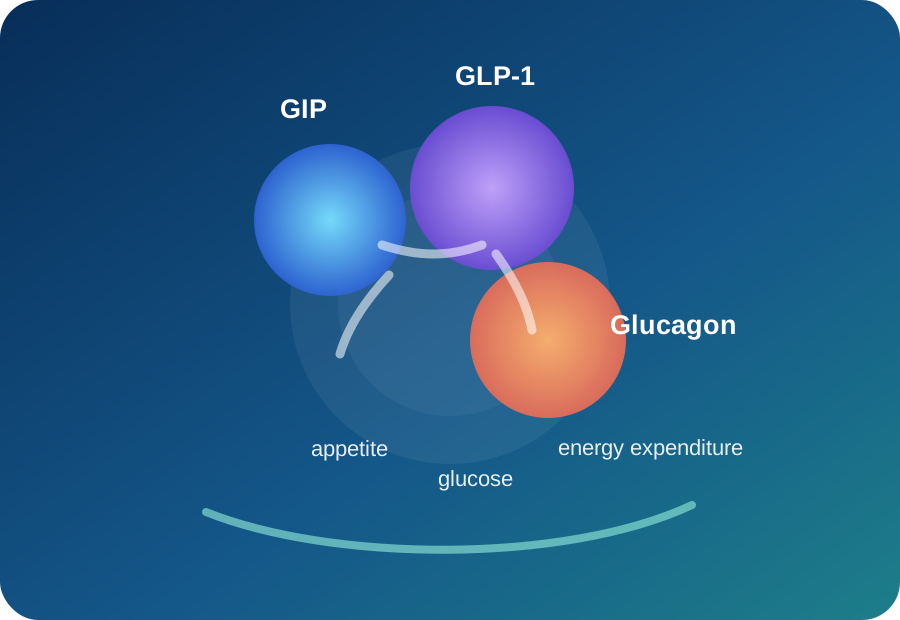
Retatrutide combines GIP, GLP-1 and glucagon receptor activity in a single investigational compound. Human research is exploring how that broader signalling profile may affect appetite, glucose control, body weight and energy balance.
01
Appetite regulation
Central and peripheral hormone signalling involved in hunger, satiety and energy intake.
02
Glucose metabolism
Changes in glycaemic control and insulin-related outcomes in people with type 2 diabetes.
03
Energy expenditure
The glucagon-receptor component adds interest around metabolic rate and substrate use.
04
Broader outcomes
Phase 3 development extends into cardiovascular disease, knee osteoarthritis and chronic kidney disease populations.
RESEARCH LANDSCAPEThree pathways · broader metabolic reach
AppetiteGlucoseWeightEnergy balance
Human research & trials
Human research & trials
Original publication · PubMed · trial registry where available
EARLY HUMAN RESEARCH
What has been explored in people?
Retatrutide has progressed through randomized human studies in type 2 diabetes and obesity, giving it a substantially deeper clinical evidence base than many research peptides.
HUMAN EVIDENCE TODAYRandomized Phase 1 and Phase 2 studies published
TYPE 2 DIABETES · 24 WEEKS−2.02%HbA1c change · 12 mg escalation arm
TYPE 2 DIABETES · 36 WEEKS−16.94%Mean weight change · 12 mg escalation arm
RESEARCH TIMELINE
How the human evidence has developed
Later-stage research increases the amount of human evidence, but publication status and regulatory approval remain separate questions.
1
Early clinicalFoundation
Human development begins
Early studies established human exposure and supported further clinical development.
2
Phase 2Peer reviewed
Obesity trial
338 adults were studied for 48 weeks in the peer-reviewed randomized obesity trial.
3
Phase 3Results reporting
TRIUMPH programme
Large late-stage trials expanded the evidence base across obesity and related populations.
4
Current statusNot approved
Still investigational
Clinical development has advanced substantially, but retatrutide is not an approved medicine.
Important distinctionA successful Phase 3 trial does not itself mean that a medicine has received regulatory approval.
Evidence snapshot
Evidence snapshot
Separate dimensions, not one overall score
◎
Human evidenceExtensive
5/5 evidence depth
Multiple randomized human trials are available, including a 338-participant Phase 2 obesity trial.
✓
Clinical efficacyStrong
4/5 evidence depth
This score reflects completed human outcome evidence. A registered or recruiting trial does not count until results are reported.
◇
Safety evidenceStrong
4/5 evidence depth
Human trial safety data exist, with gastrointestinal adverse events prominent and dose-related; long-term safety remains under study.
⌁
Preclinical evidenceStrong
4/5 evidence depth
Mechanistic and preclinical development support triple-receptor agonism, but human evidence is scored separately.
HOW TO READ THESE SCORESStrong preclinical evidence · extensive human evidence
These are editorial evidence-depth ratings on a 1–5 scale, not a statistical result or a single scientific formula. They summarise how much relevant evidence is present in each separate category and how mature that evidence is.
Human evidenceHow much direct research in people is available and how developed it is.
Clinical efficacyWhether human studies demonstrate meaningful outcomes for the claims being discussed.
Safety evidenceHow much human safety, tolerability and longer-term follow-up information is available.
Preclinical evidenceThe depth of laboratory and animal research supporting biological plausibility.
MECHANISM
A triple receptor agonist
Retatrutide activates three metabolic hormone receptor pathways. Receptor activity explains the mechanism being investigated — it does not by itself prove a clinical benefit.
GIPreceptor
+
GLP-1receptor
+
Glucagonreceptor
↓
Metabolic effects under investigationAppetite, energy intake, glucose regulation and energy expenditure
Important: Mechanism ≠ proven clinical efficacy. Human outcomes are assessed separately below.
From promising signals to human evidencePreclinical research can reveal promising biological signals. Human studies show how far those signals have translated into real-world outcomes.
What people are exploring
PEOPLE & EXPERIENCE
What people are exploring
Recurring themes from peptide and wellness communities, shown alongside what published research currently suggests.
Experience + research context
Why this matters
Online discussions commonly focus on appetite/food-noise changes, energy or fatigue, gastrointestinal effects, sleep and heart-rate sensations. These reports are observational self-reports and do not establish causation.
◎WHAT PEOPLE REPORTReal-world interest
Experiences can reveal recurring goals, perceived changes and practical questions that formal studies may not yet address. They can suggest what deserves investigation, but cannot isolate the effect of one compound from rehabilitation, time or other changes.
+
⌁WHAT RESEARCH ADDSScientific context
Human and preclinical research helps test whether an idea is biologically plausible, whether it appears in people and how confidently the result can be separated from chance, bias or other parts of recovery.
Frequently discussedMostly positive
Reduced food noise / easier appetite control
HUMAN RESEARCH
Supported directionally
PRECLINICAL RESEARCH
Not needed for verdict
WHERE IT STANDS TODAY
Clinical evidence supports appetite/weight effects; community language such as “food noise” is less formally measured.
Commonly discussedMixed
More energy / higher drive
HUMAN RESEARCH
Uncertain
PRECLINICAL RESEARCH
Mechanistically plausible but not established as a benefit
WHERE IT STANDS TODAY
Community reports conflict: increased energy and fatigue are both prominent. Treat as hypothesis-generating.
Commonly discussedNegative
Fatigue / low energy
HUMAN RESEARCH
Reported adverse experience
PRECLINICAL RESEARCH
Not a benefit claim
WHERE IT STANDS TODAY
Reported online and in real-world discussion; attribution can be confounded by reduced intake, other compounds and product variability.
Frequently discussedMixed-positive
Changes in cravings / food preference
HUMAN RESEARCH
Plausible / partially supported
PRECLINICAL RESEARCH
Not decisive
WHERE IT STANDS TODAY
Appetite and craving changes are repeatedly reported, but the exact subjective experience is not equivalent to a clinical endpoint.
◇
Experience can start the question. Research has to test it.
Community reports can surface patterns worth exploring. Controlled human research is what tests whether those patterns are reliable, clinically meaningful and attributable toRetatrutide, while the available studies show how far that question has already been answered.
Dose & duration
DOSE & DURATION
See the numbers in their proper context
Compare published study protocols with the patterns people discuss in the community. The two are intentionally kept separate so an anecdotal routine is never mistaken for clinical guidance.
Research protocols · community patterns · calculator tools
Research dose ≠ recommendation. A dose used in a study describes that study only and does not establish an appropriate dose for an individual outside the research setting.
CALCULATOR TOOLS
Work with the numbers
Convert amounts, concentration, liquid volume and vial requirements. These tools do the arithmetic; they do not select a dose.
Dose-ranging research protocol; not a recommendation.
↗
HOW TO READ THE STEP-UPThe start and target come from the published protocol.
The visual shows the opening amount, target amount and total study window. It does not invent intermediate steps: the linked paper or authorised product information remains the source for the complete escalation schedule.
COMMUNITY DISCUSSION
What people commonly discuss
Community theories only
STARTING APPROACHES
Community starting-dose discussions exist, but the app does not treat them as validated clinical protocols.
DURATION / CYCLES
Long-term and maintenance use are widely discussed because weight-regain prevention is a major topic in incretin communities.
MAINTENANCE DISCUSSION
No validated retatrutide maintenance dose can be inferred from online practice. Clinical development data should remain the primary dosing evidence.
Community patterns are anecdotal and unvalidated unless a linked human study independently supports the same approach.
Often combined with
OFTEN COMBINED WITH
Why people explore pairings with Retatrutide
See the thinking behind community-named stacks, the different role each component is proposed to play, and how much of that idea has actually been tested as a combination.
Community rationale · component roles · evidence boundary
Potential first, evidence in context. Pairings are usually explored because their research stories appear complementary. That makes them interesting to study, but does not yet prove extra benefit or safety.
CURRENT COMPOUNDRetatrutide
→
OFTEN EXPLORED WITHRetatrutide + Cagrilintide
Retatrutide + Cagrilintide
→
OFTEN EXPLORED WITHRetatrutide + NAD+
Retatrutide + NAD+
Combination-specific human research is the strongest evidence for what a pairing adds. Evidence for either ingredient alone should not be silently transferred to the combination.
Higher-dose clinical-trial groups have reported average weight reductions in this range. This is a group average, not an expected result for every individual.