
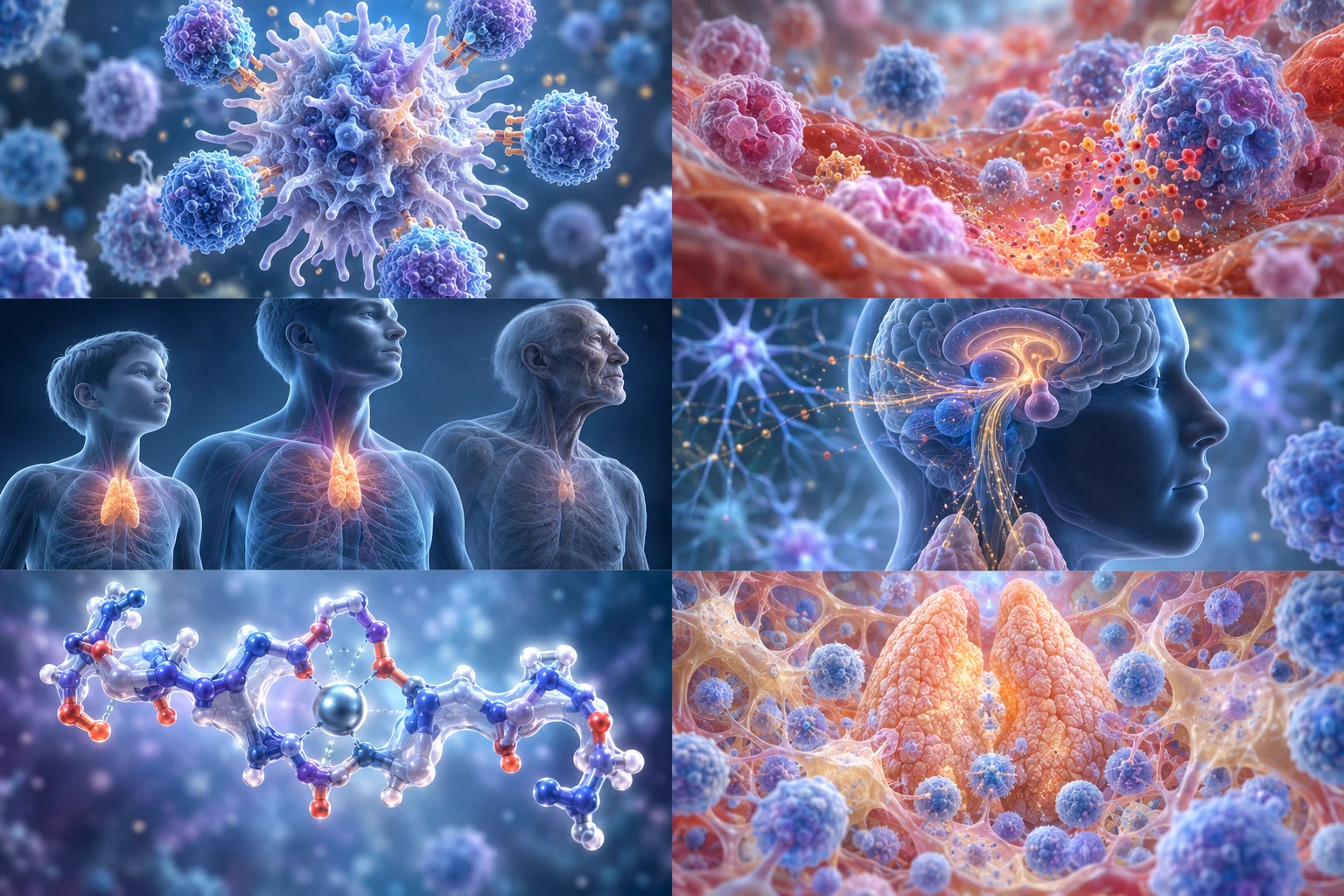
Immune regulation
Thymulin is produced by the thymus, an organ central to T-cell development and immune coordination.
Explore the research →
A thymus-linked hormone that has attracted interest around immune balance, inflammation and the way immune function changes with age.
Thymulin sits at an interesting crossroads between the thymus, the immune system and hormone signalling. Because thymic function changes with age, it has attracted interest around immune balance, inflammation and the wider biology of ageing.
Thymulin is produced by the thymus, an organ central to T-cell development and immune coordination.
Explore the research →Experimental work suggests thymulin-related signalling can influence inflammatory responses.
Explore the research →Thymulin levels and thymic activity change across the lifespan.
Explore the research →Growth hormone, thyroid hormones and other endocrine signals interact with thymulin production.
Explore the research →Thymulin is a nine-amino-acid thymic peptide whose biological activity depends on zinc binding. The peptide and the metal together form the active hormonal complex.
Research connects this complex with T-cell biology and communication between the immune and endocrine systems. That zinc dependence is normal chemistry, not evidence that adding thymulin or zinc improves immunity in everyone.
See the studies & trials →Human physiology is established more clearly than administered-treatment benefit.
Read a primary source ↗These are the tissues and biological systems behind the interest in Thymulin.
Thymulin is produced by the thymus, an organ central to T-cell development and immune coordination.
Human observational work confirms circulating thymulin responds to endocrine state, but administered thymulin has not been established as an immune treatment.
Established biology · experimental treatmentExplore the studies →Experimental work suggests thymulin-related signalling can influence inflammatory responses.
Most therapeutic anti-inflammatory findings come from laboratory and animal research rather than controlled human trials.
Preclinical evidenceExplore the studies →Thymulin levels and thymic activity change across the lifespan.
That makes it relevant to ageing biology, but there is no demonstrated anti-ageing treatment effect from thymulin administration.
Human biology · efficacy unprovenExplore the studies →Growth hormone, thyroid hormones and other endocrine signals interact with thymulin production.
These relationships help explain scientific interest without proving that supplementing thymulin improves hormone balance.
Human mechanistic evidenceExplore the studies →Human and experimental literature
Children with growth-hormone deficiency and healthy controls
Human studies measure endogenous thymulin and endocrine relationships.
No established therapeutic efficacy programme supports routine thymulin treatment.
A modern administered-product safety dataset is lacking.
Substantial mechanistic and animal literature explores immune and inflammatory effects.
These are editorial evidence-depth ratings on a 1–5 scale, not a statistical result or a single scientific formula. They summarise how much relevant evidence is present in each separate category and how mature that evidence is.
Research themes are shown separately from the strength of the human evidence so biological interest is not confused with proven clinical benefit.
Interest centres on immune ageing, inflammation and thymic function, but administered thymulin remains experimental.
Explore the everyday goalsWhat the desired change means in daily life, and what makes an experience useful to understand.
Interest centres on remaining well through periods of stress or recovering after illness. Thymic biology explains why the peptide attracts attention, but it does not establish fewer infections from taking it.
People are interested in less inflammatory burden rather than simply greater immune activity. The mechanism is more nuanced than an immune-boosting label suggests.
Age-related thymic changes attract preventive interest in maintaining immune function. That motivation is different from evidence that treatment improves healthspan.
Open an area to distinguish human findings from laboratory explanations.
Human observational work confirms circulating thymulin responds to endocrine state, but administered thymulin has not been established as an immune treatment.
Evidence context: Established biology · experimental treatment
Most therapeutic anti-inflammatory findings come from laboratory and animal research rather than controlled human trials.
Evidence context: Preclinical evidence
That makes it relevant to ageing biology, but there is no demonstrated anti-ageing treatment effect from thymulin administration.
Evidence context: Human biology · efficacy unproven
These relationships help explain scientific interest without proving that supplementing thymulin improves hormone balance.
Evidence context: Human mechanistic evidence
Thymulin is a nine-amino-acid thymic peptide whose biological activity depends on zinc binding. The peptide and the metal together form the active hormonal complex.
Research connects this complex with T-cell biology and communication between the immune and endocrine systems. That zinc dependence is normal chemistry, not evidence that adding thymulin or zinc improves immunity in everyone.
See the amount, how often it was used and how long each study ran. Published human research and community descriptions each carry their own source label, so you can see where the numbers came from.
No validated therapeutic thymulin dose or consumer protocol has been established.
Convert amounts, concentration, liquid volume and vial requirements. These tools do the arithmetic; they do not select a dose.
Purity, identity, quantity, sterility and endotoxin testing answer different questions. Learn how to read a COA and why a high purity percentage is not the same as confirming the amount in the vial.
A dose only makes sense alongside the population, route, frequency and duration. Start with where the number came from, then look at how it was delivered and how long the study actually ran.
Was it an authorised label, a human trial or a community-described pattern?
How was it given, and how often? The same number by a different route may not mean the same exposure.
Was this one dose, a short trial or long-term treatment? A study window is not automatically a recommended cycle.
Route means how a compound was delivered. It affects absorption and can completely change how a study should be interpreted.
An injection into the fatty layer just under the skin.
Common in peptide and metabolic-drug studies. It usually aims for systemic absorption rather than treating only the spot injected.An injection into muscle tissue.
Muscle can absorb a medicine differently from fat. An IM amount should not be assumed to be equivalent to a SubQ amount.Delivered directly into a vein.
This gives immediate bloodstream exposure and is commonly used in supervised research or clinical settings. It is not interchangeable with a home injection route.Delivered through the nose rather than by injection.
The amount delivered depends on formulation and device. A spray count alone does not tell you the dose unless concentration and spray volume are known.Human measurements of thymulin activity do not establish a treatment amount. A fixed-dose clinical course cannot be derived from the thymus biology literature. Keep amounts manual and tied to an independently specified record.
Form and route: Laboratory and endogenous-hormone research
The planner keeps amounts and repeat patterns blank for this compound. Use its formulation guide to record an independently specified schedule.
One thousand micrograms (mcg).
One thousandth of a milligram.
The amount is calculated for each kilogram of body weight.
A measure of biological activity used for some medicines; it cannot be converted to mg without compound-specific information.
For example SubQ, IM, IV, intranasal, oral or topical.
For example once daily, twice weekly or every seven days.
A protocol changes the amount over time rather than using one fixed amount throughout.
The time taken for the amount of a compound in the body to reduce by roughly half. It can influence study timing but does not by itself define a schedule.
Usually means an on-period followed by a stop or review. Many community 'cycles' have not been clinically validated.
A longer-term amount or interval used after an initial phase when a study or authorised treatment actually defines one.
Adding a specified liquid to a freeze-dried vial so a concentration can be calculated.
100 units equals 1 mL on a U-100 insulin syringe. The markings show volume, not peptide mass.
The summary above reflects the human or preclinical evidence currently represented on this profile.
Limited follow-up, small studies or absent controlled trials can leave uncommon and longer-term risks unresolved.
Route, product identity, quality and regulatory status can materially change the safety context; see the linked status sources below.
Follow the professional sources used across this profile, then see how the compound is currently described in regulatory and research terms.
Thymulin is presented here for research context. Availability online does not establish medicine quality, safety or efficacy.
MHRA products database ↗Published research and commercial availability are separate from regulatory approval.
Drugs@FDA ↗Profile reviewed against its linked source record on 20 September 2026. See how evidence is assessed.
Save peptides, build plans, set reminders and keep track of your own supplies in a private My Explorer space.